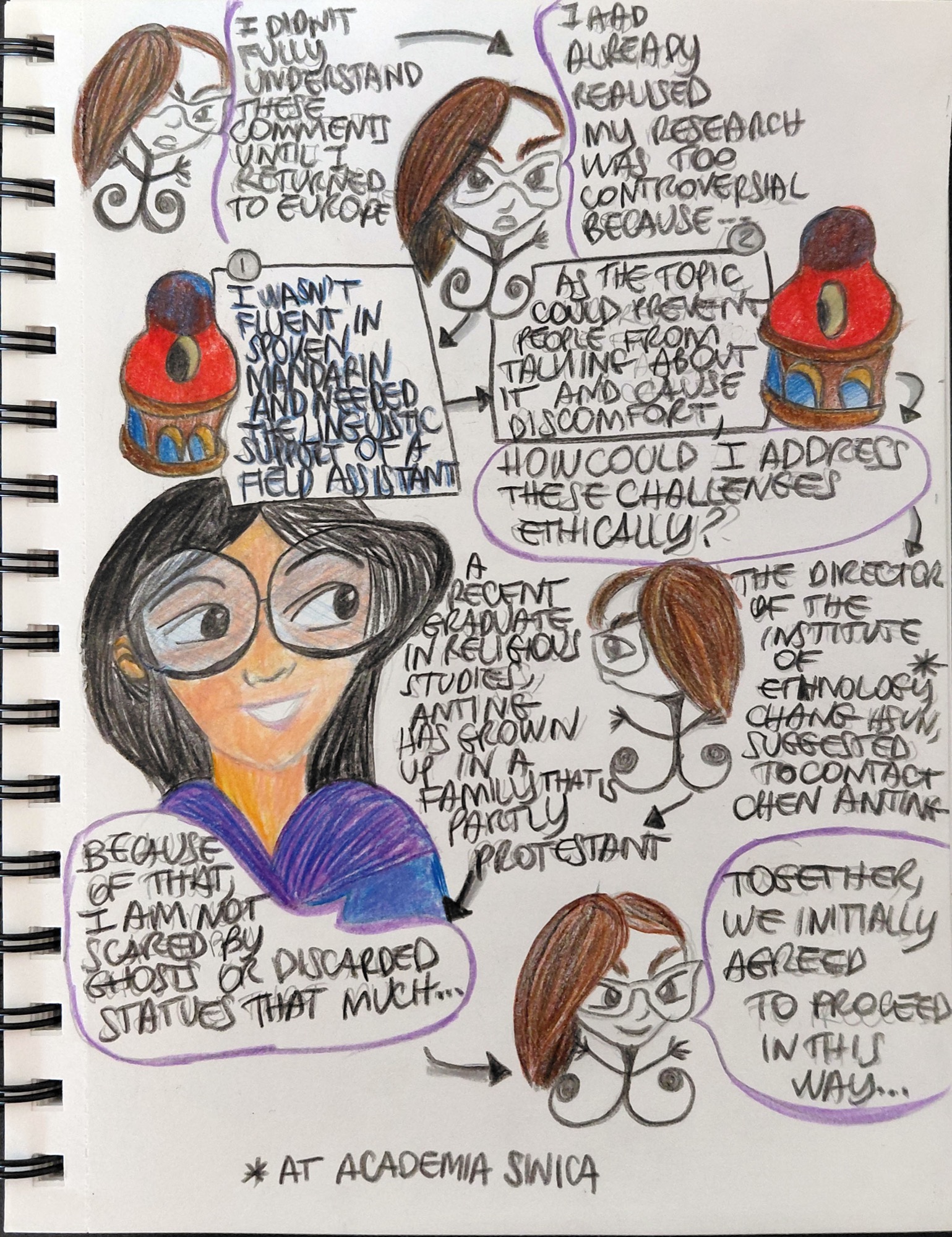
I did not fully understand these comments (of my fieldwork interlocutors) until I returned to Europe. I had already realised my research was too controversial because… 1. I wasn’t fluent in spoken Mandarin and needed the linguistic support of a field assistant. 2. As the topic could prevent people from talking about it and cause discomfort, how could I address these challenges ethically?
The director of the Institute of Ethnology at Academia Sinica, Hsun Chang, suggested that I contact Anting Chen. A recent graduate in religious studies, Anting grew up in a family that is partly Protestant. “Because of that, I am not scared by ghosts or discarded statues that much…” Together, we initially agreed to proceed in this way…
*Click on the first image to open the photo gallery and read the captions.
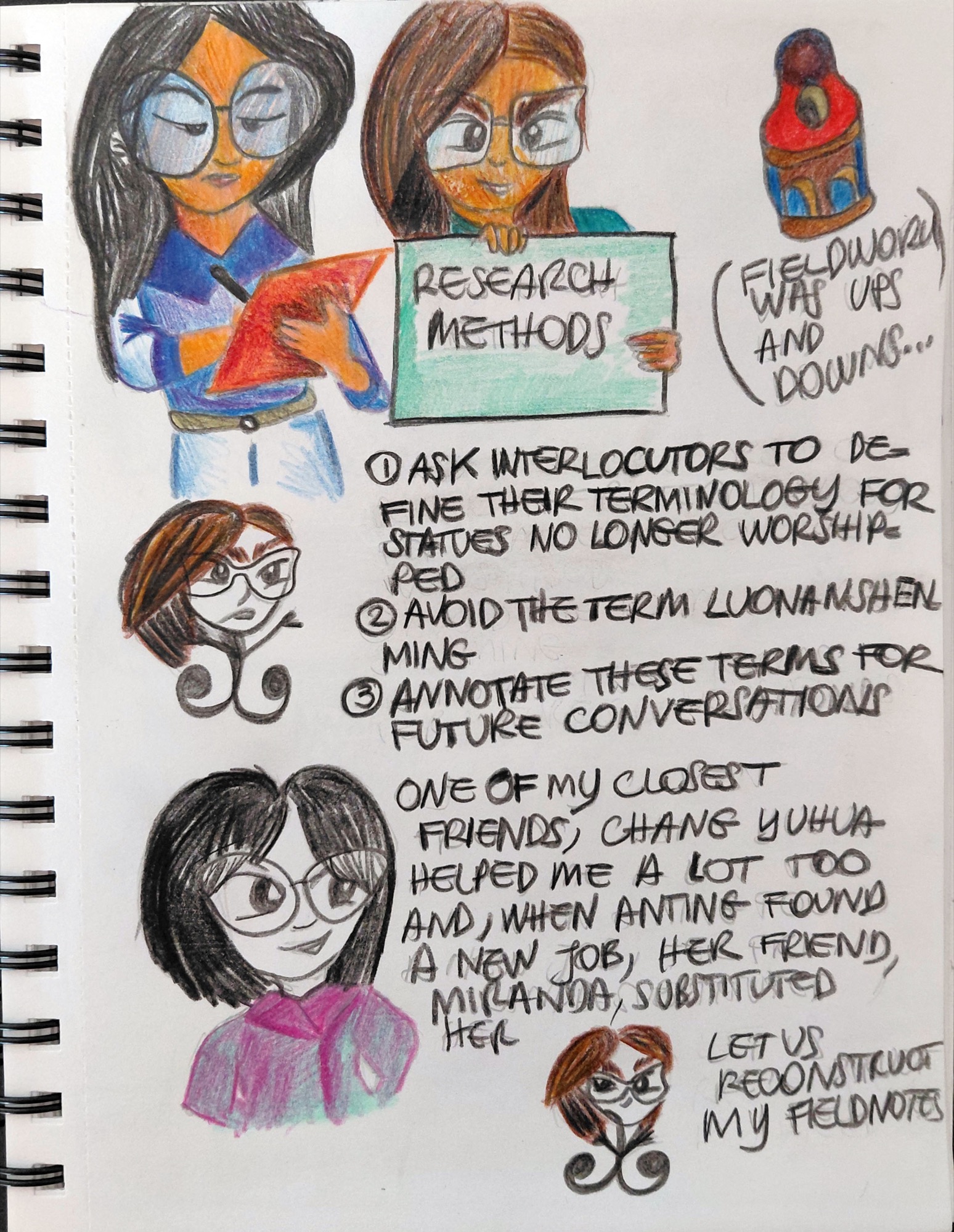
(Fieldwork was ups and downs)
- Ask interlocutors to define their terminology for statues no longer worshipped;
- Avoid the term luonanshenming;
- Annotate these terms for future conversations
One of my closest friends, Yuhua Chang, helped me a lot too, and, when Anting found a new job, her friend Miranda substituted her.
Let us reconstruct my fieldnotes.
“Fieldnotes”

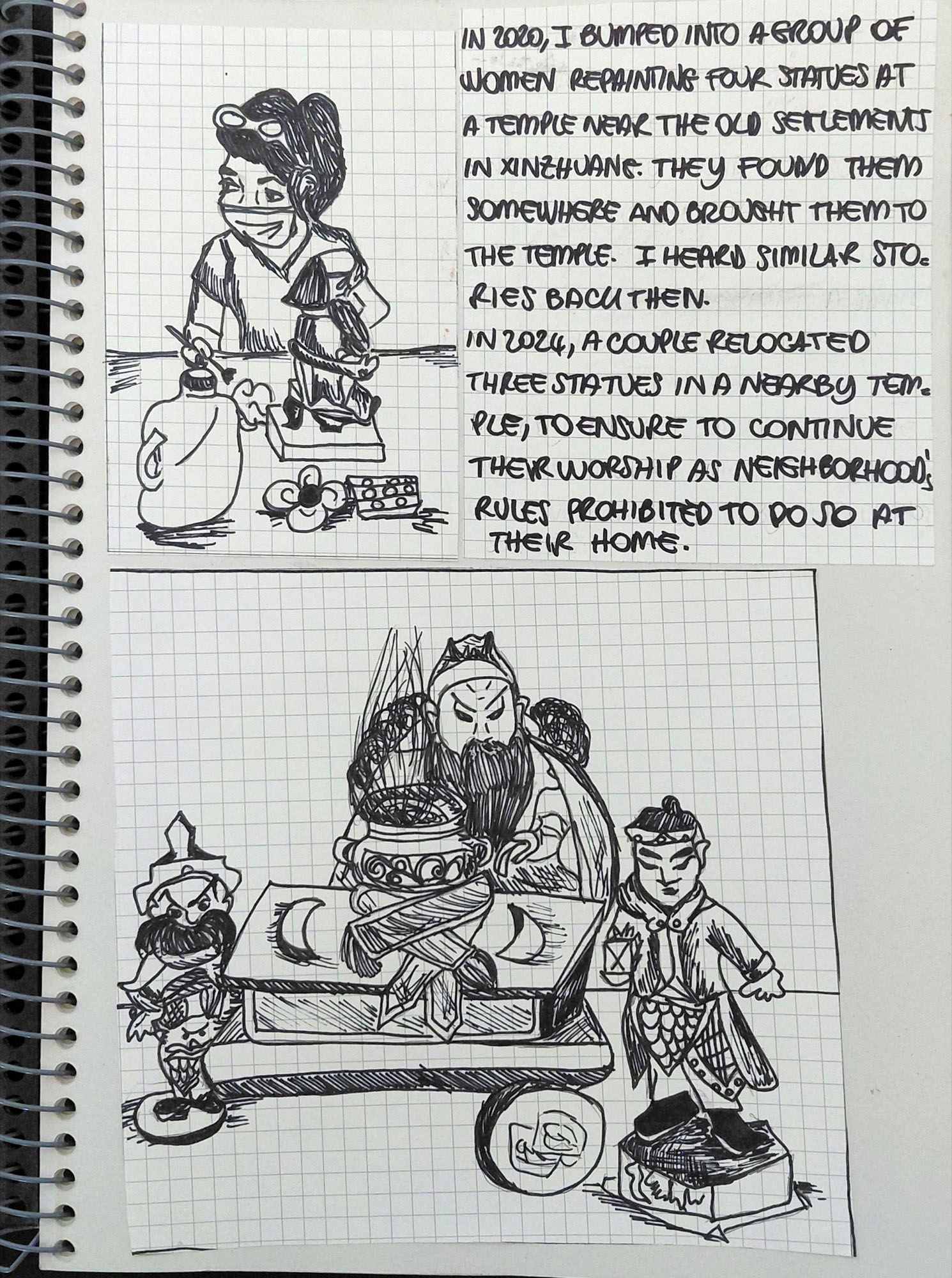
In 2020, I bumped into a group of women repainting four statues at a temple near the old settlements in Xinzhuang. They found them somewhere and brought them to the temple. I heard similar stories back then.
In 2024, a couple relocated three statues in a nearby temple, to ensure to continue their worship as neighborhoods’ rules prohibited to do so at their home.
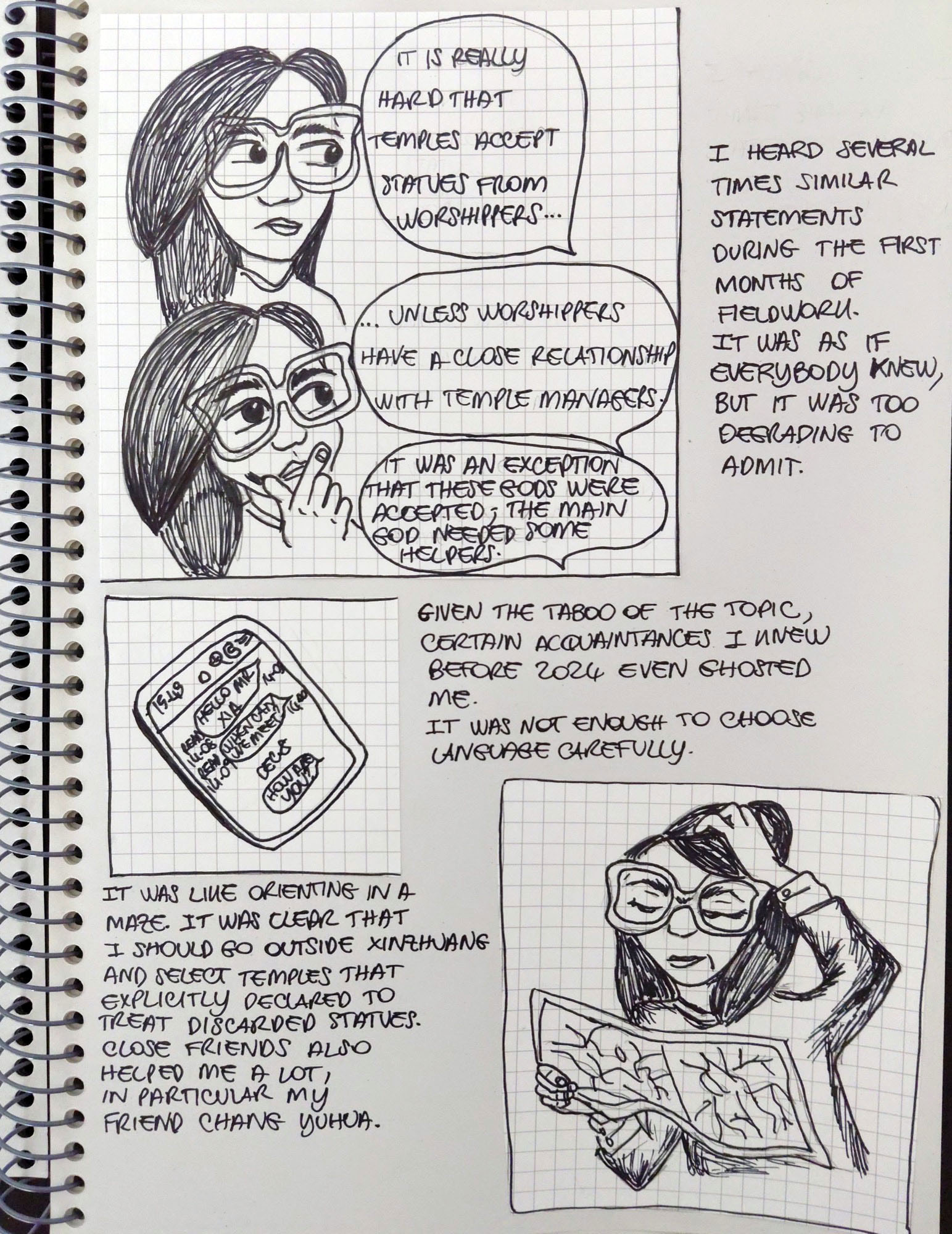
“It is really hard that temples accept statues from worshippers…” “…Unless worshippers have a close relationship with temple managers.” “It was an exception that these gods were accepted; the main god needed some helpers.” I heard several times similar statements during the first months of fieldwork. It was as if everybody knew, but it was too degrading to admit.
Given the taboo of the topic, certain acquaintances I knew before 2024 even ghosted me. It was not enough to choose language properly.
It was like orienting in a maze. It was clear that I should go outside Xinzhuang and select temples that explicitly declared to treat discarded statues. Close friends also helped me a lot, in particular my friend Yuhua Chang.
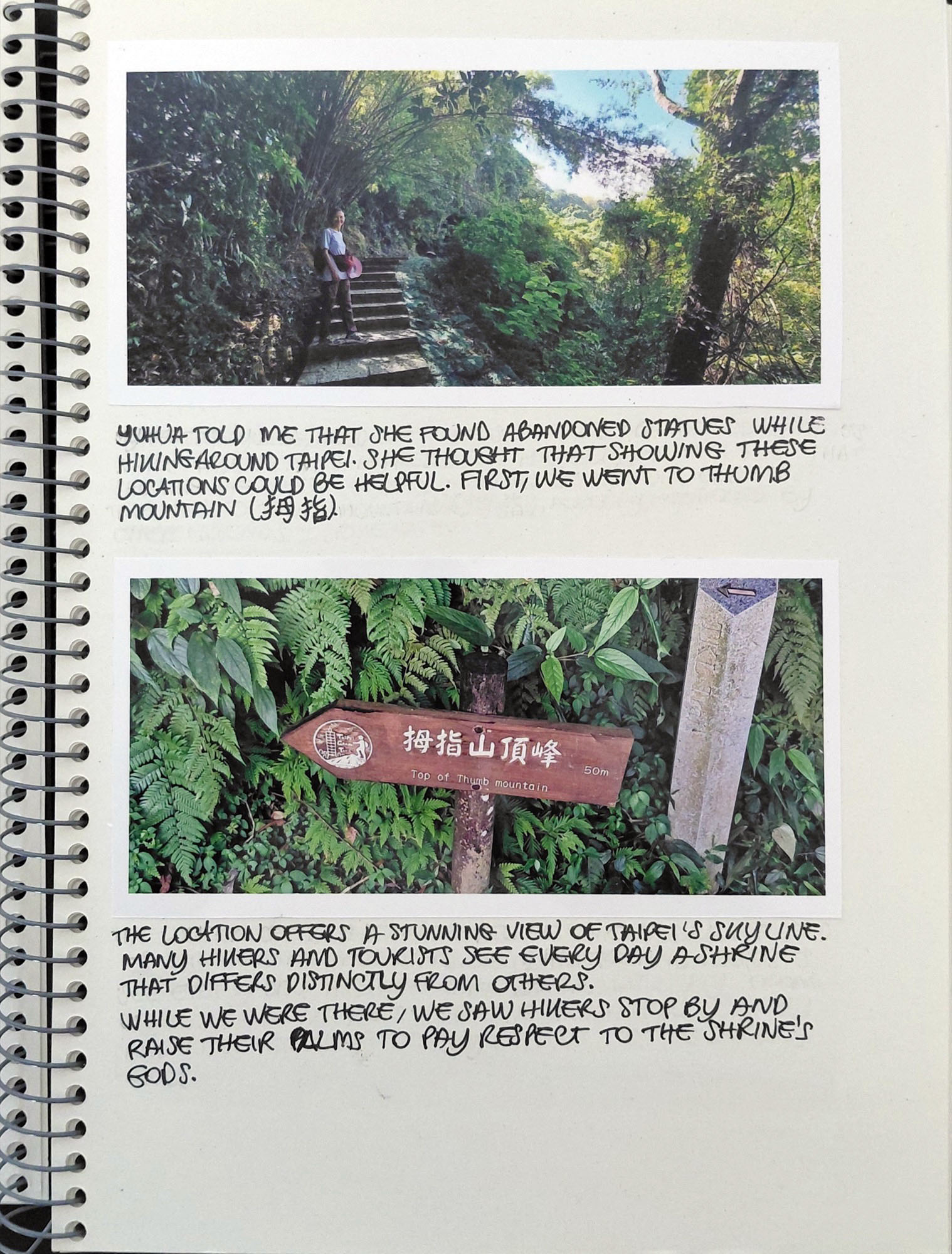
Yuha told me that she found abandoned statues while hiking around Taipei. She thought that showing these locations could be helpful. First, we went to Thumb Mountain (拇指山).
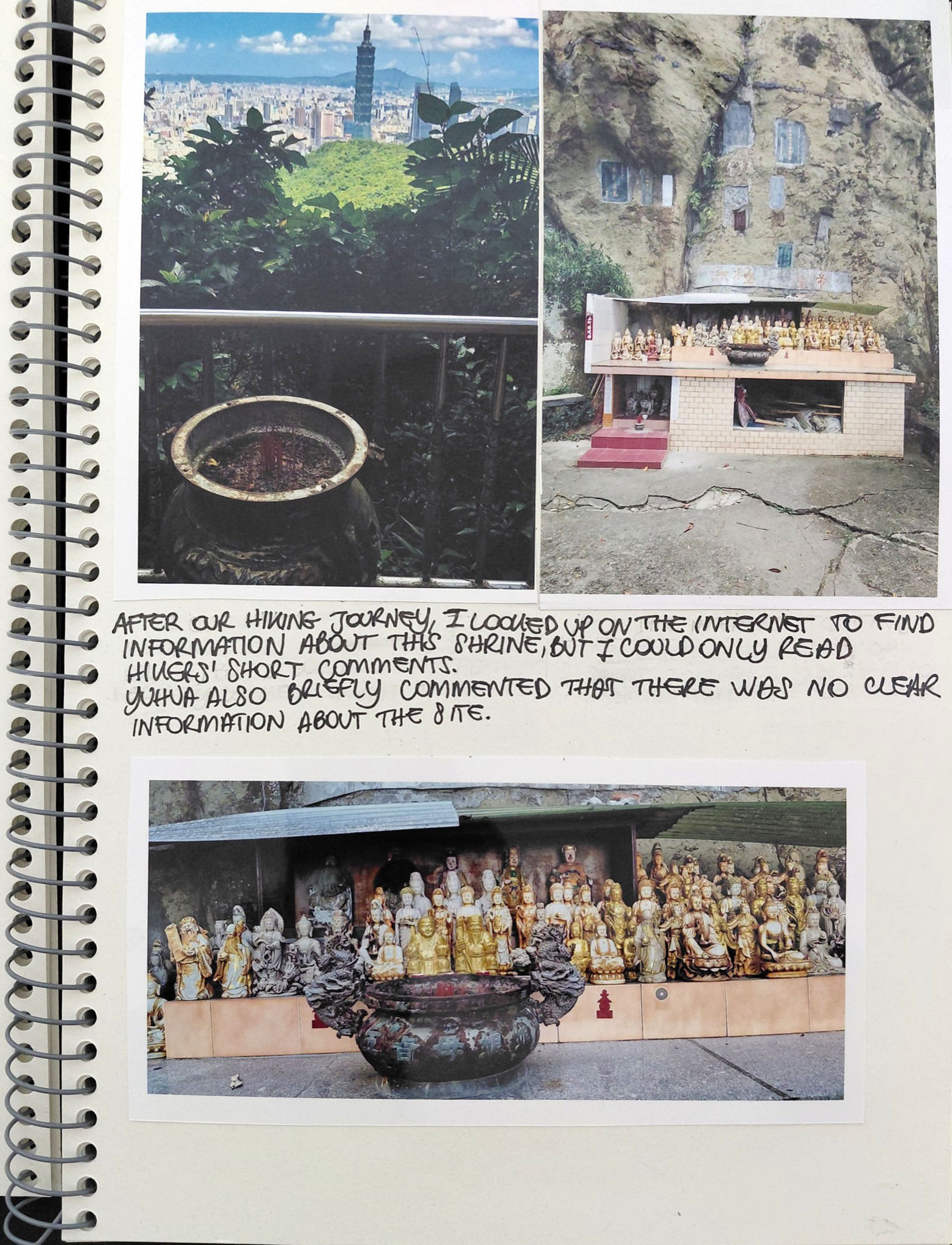
The location offers a stunning view of Taipei’s skyline. Many hikers and tourists see every day a shrine that differs distinctively from others. While we were there, we saw hikers stop by and raise their palms to pay respect to the shrine’s gods.
After our hiking journey, I looked up on the Internet to find information about this shrine, but I could only read hikers’ short comments. Yuhua also briefly commented that there was no clear information about the site.
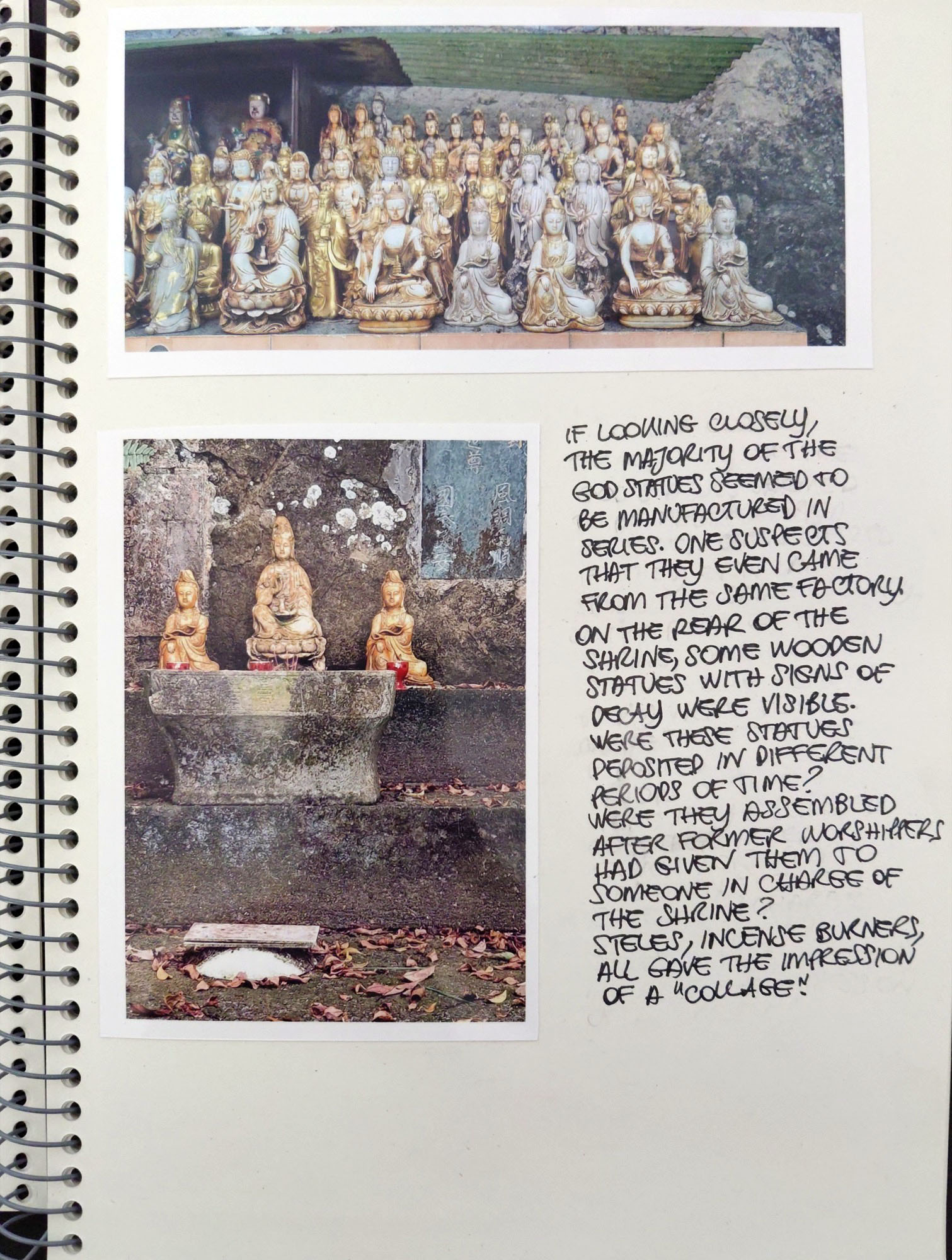
If looking closely, the majority of the god statues seemed to be manufactured in series. One suspects that they even came from the same factory. On the rear of the shrine, some wooden statues with signs of decay were visible. Were these statues deposited in different periods of time? Were they assembled after former worshippers had given them to someone in charge of the shrine? Steles, incense burners, all gave the impression of a “collage.”
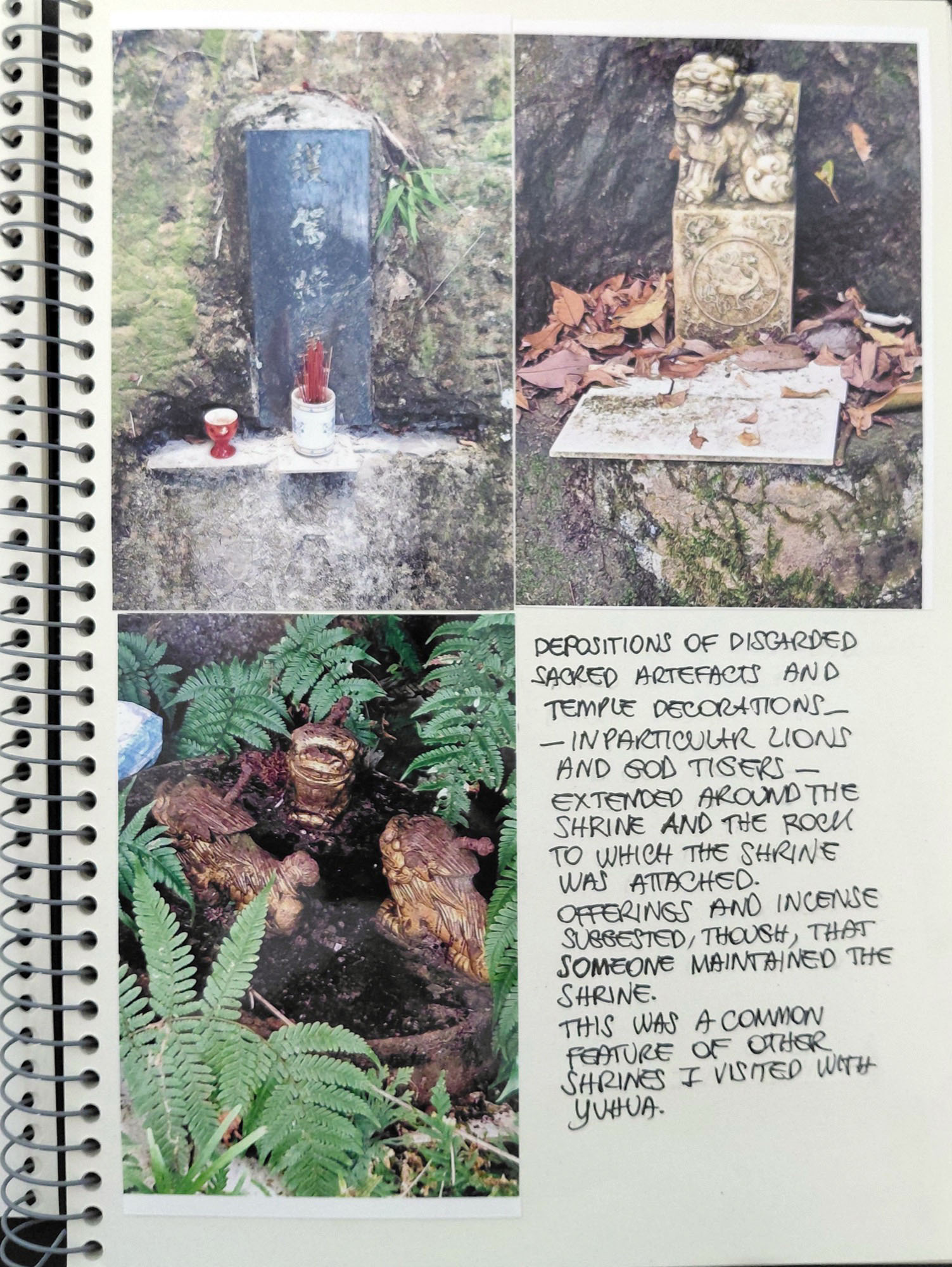
Depositions of discarded sacred artefacts and temple decorations—in particular lions and god tigers—extended around the shrine and the rock to which the shrine was attached. Offerings and incense suggested, though, that someone maintained the shrine. This was a common feature of other shrines I visited with Yuhua.
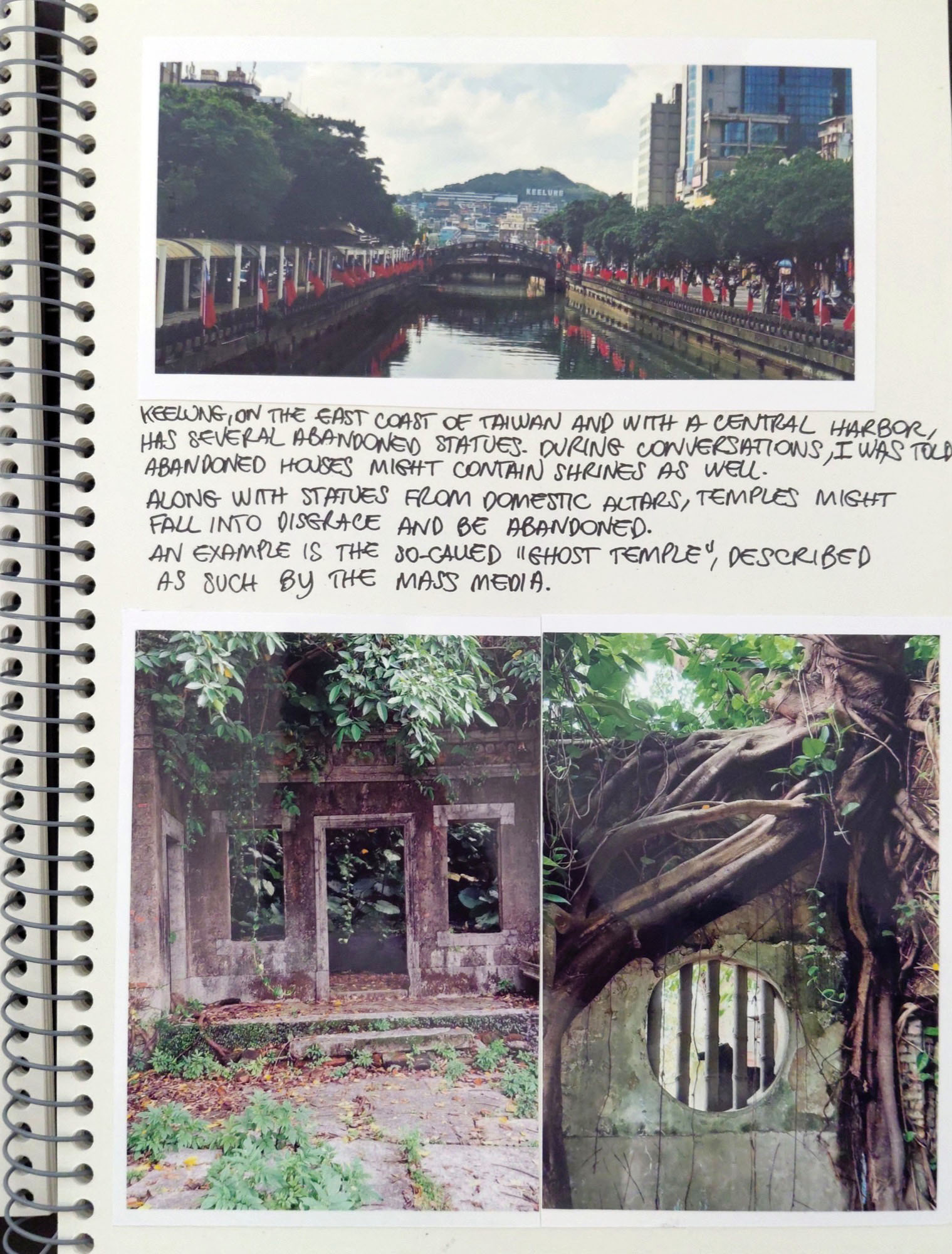
Keelung, on the East coast of Taiwan and with a central harbor, has several abandoned statues. During conversations, I was told abandoned houses might contain shrines as well. Along with statues from domestic altars, temples might fall into disgrace and be abandoned. An example is the so-called “ghost temple”, described as such by the mass media.
Yuhua told me that she was going to the same neighborhood where the “ghost temple” was located and invited me to join the trip. I partly chatted with Yuhua’s group, partly explored the area.
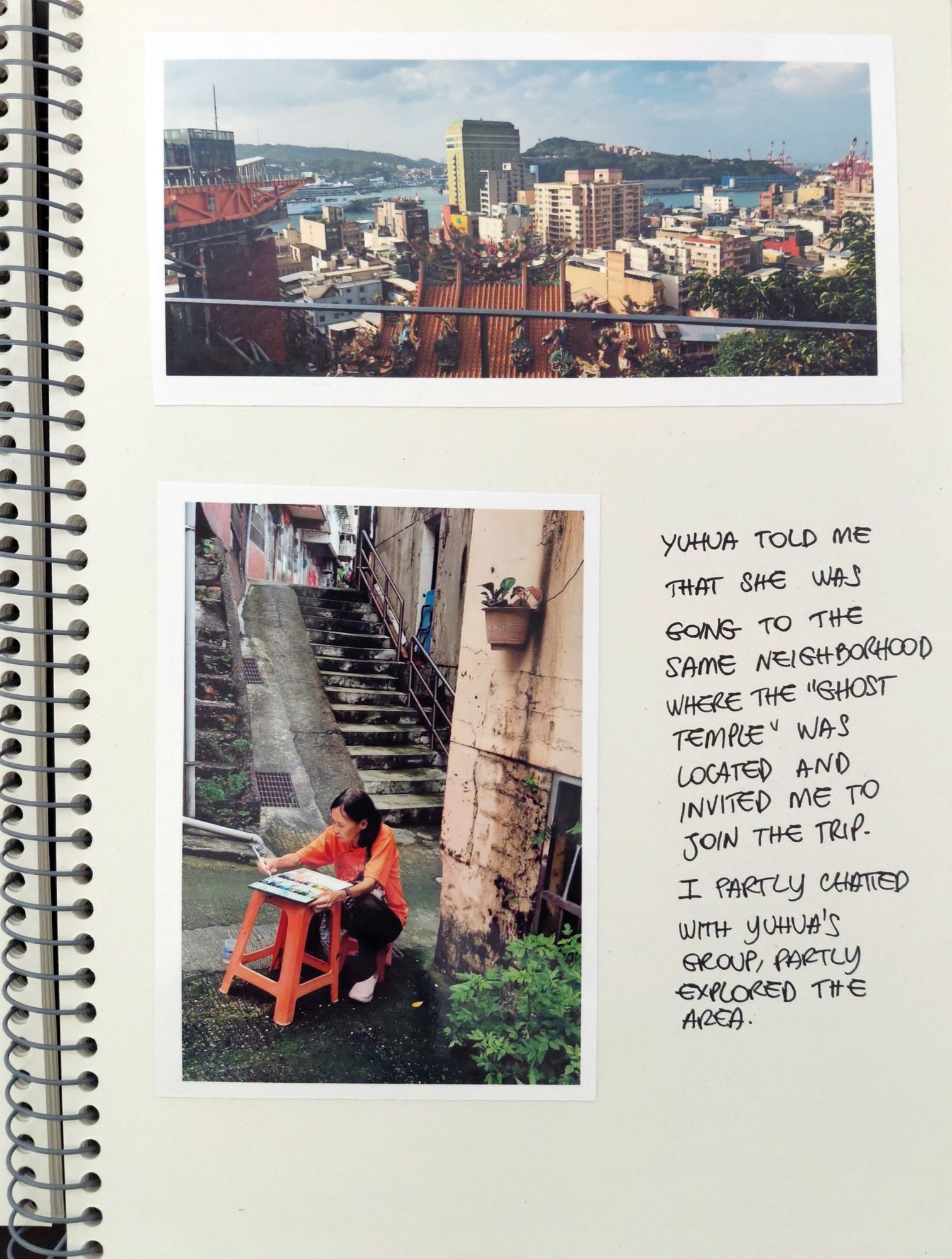
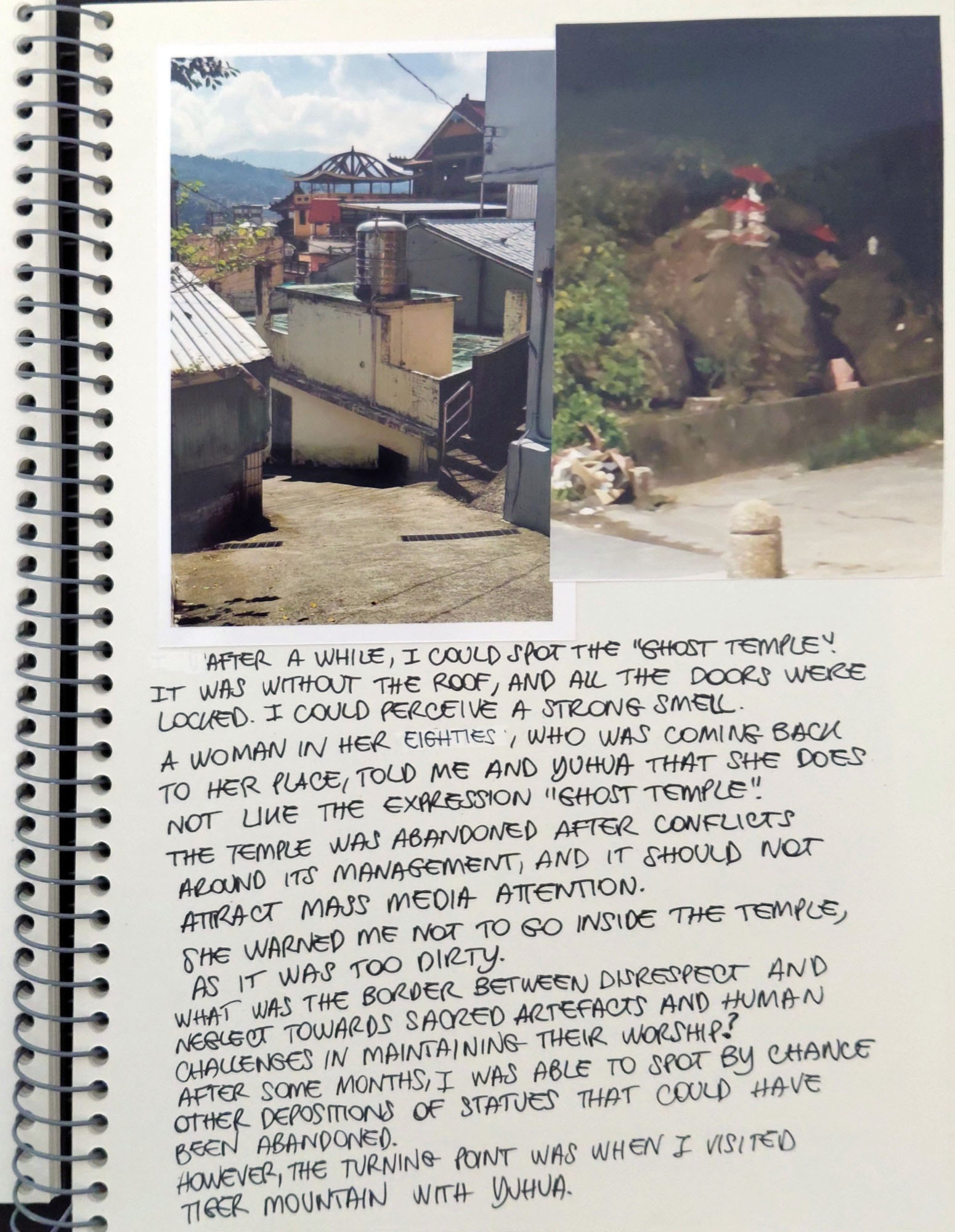
After a while, I could spot the “ghost temple”. It was without the roof, and all the doors were locked. I could perceive a strong smell. A woman in her eighties, who was coming back to her place, told me and Yuhua that she does not like the expression “ghost temple.” The temple was abandoned after conflicts around its management and it should not attract mass media attention. She warned me not to go inside the temple, as it was too dirty.
What was the border between disrespect and neglect towards sacred artefacts and human challenges in maintaining their worship? After some months, I was able to spot by chance other depositions of statues that could have been abandoned. However, the turning point was when I visited Tiger Mountain with Yuhua.
This third journey with Yuhua, on a rainy day, further revealed specific mechanisms involving temples that usually remain in the background and are rarely acknowledged by temple managers. Tiger Mountain (虎山) has several ephemeral shrines built for abandoned statues. As in Muzhishan, some put offerings and incense, suggesting a regular maintenance of the shrines.
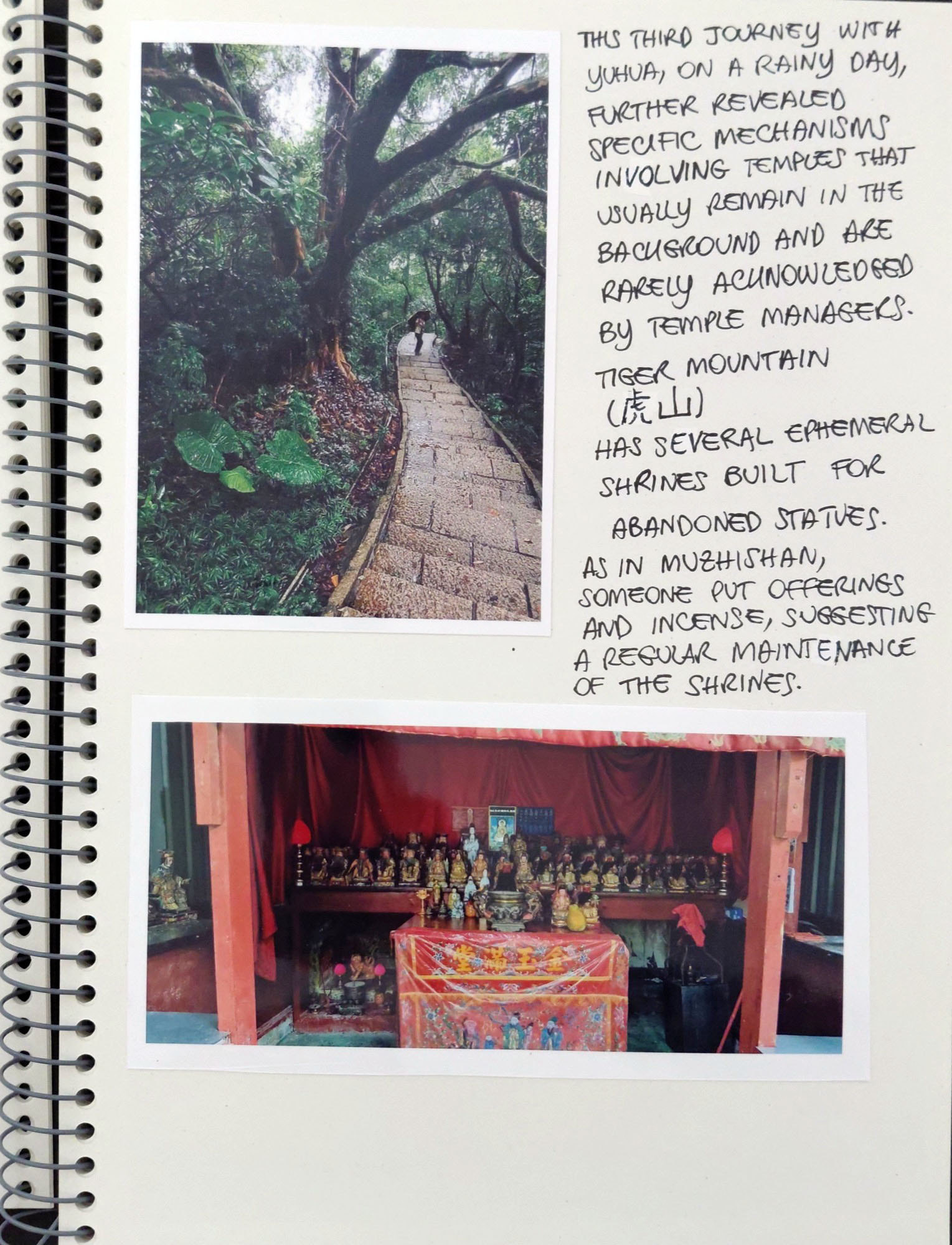
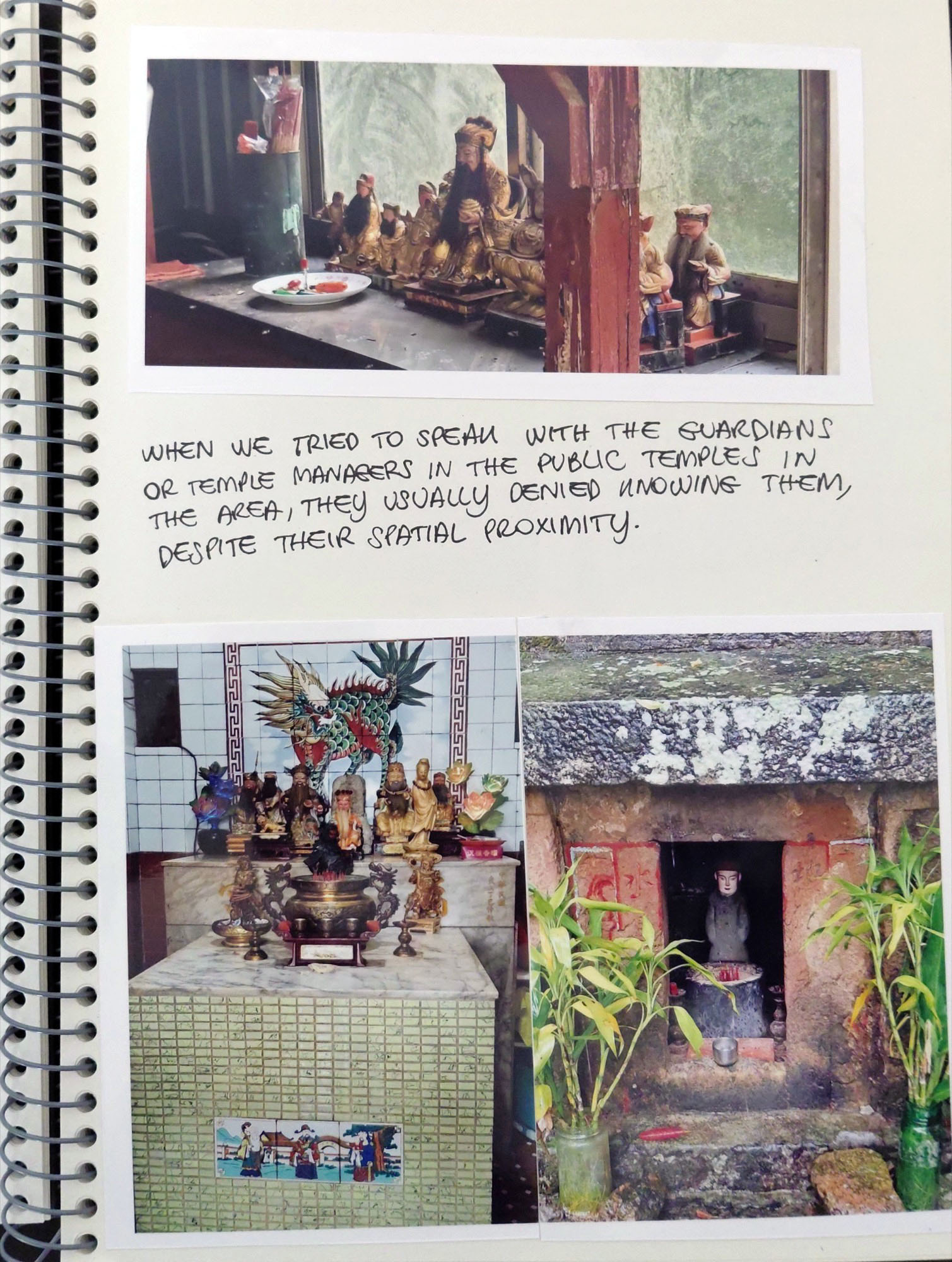
When we tried to speak with the guardians or temple managers in the public temples in the area, they usually denied knowing them, despite their spatial proximity.
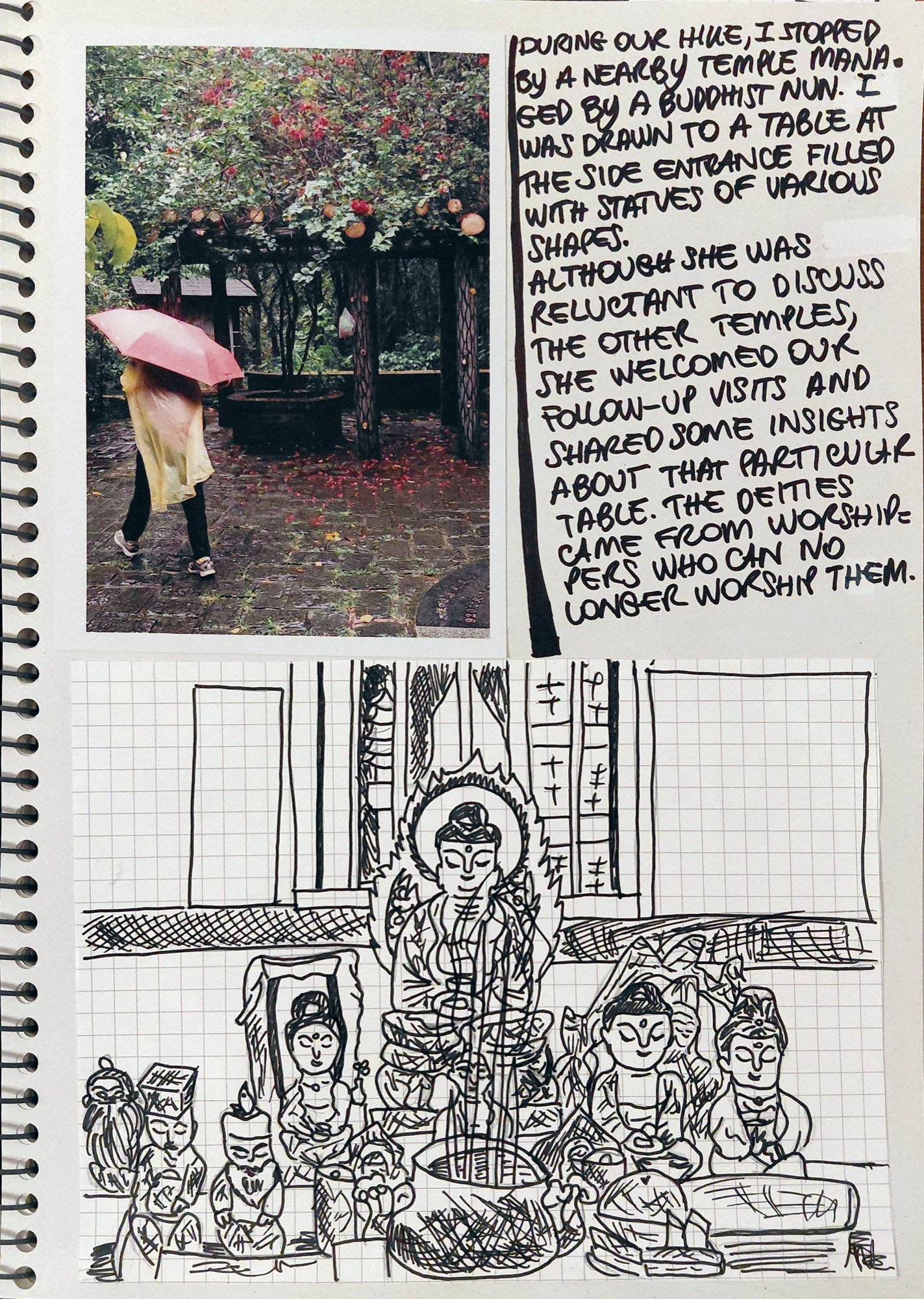
During our hike, I stopped by a nearby temple managed by a Buddhist nun. I was drawn to a table at the side entrance filled with statues of various shapes. Although she was reluctant to discuss the other temples, she welcomed our follow-up visits and shared some insights about that particular table. The deities came from worshippers who can no longer worship them.
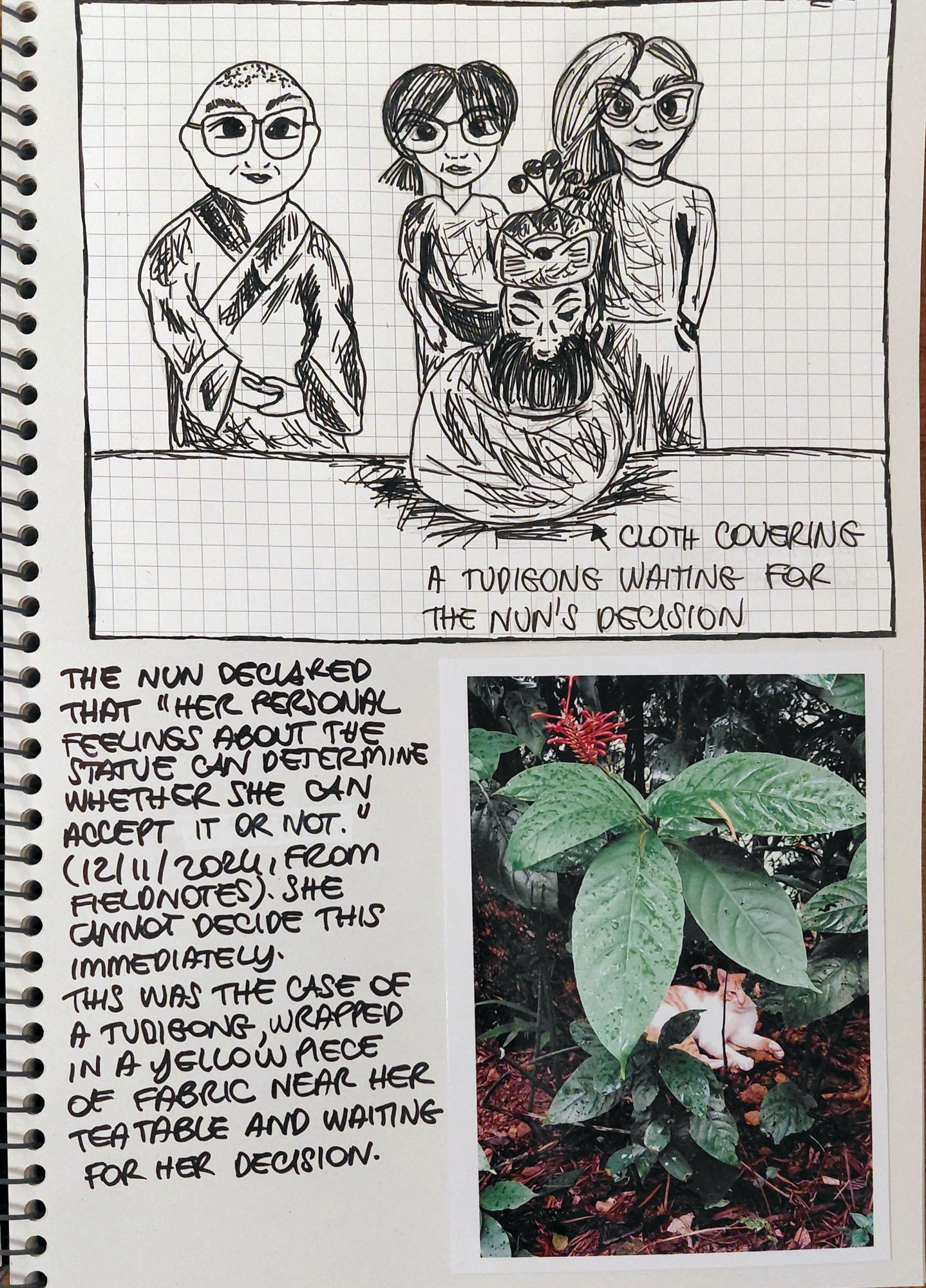
She declared that “her personal feelings about the statue determine whether she can accept the statue or not” (12/11/2024, from fieldnotes). She cannot decide this immediately. This was the case of a Tudigong (wrapped with a yellow piece of fabric while) waiting for her decision.
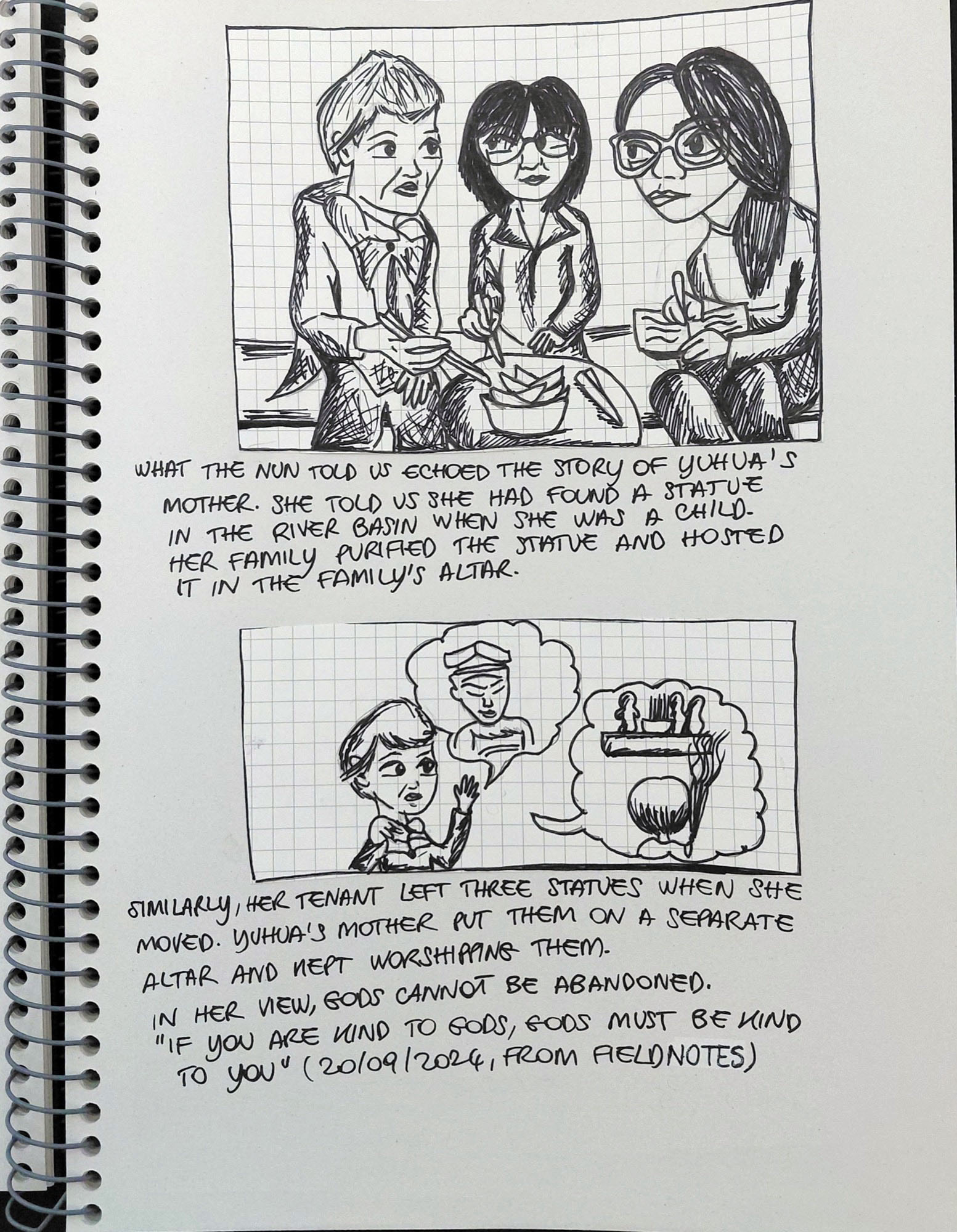
What the nun told us echoed the story of Yuhua’s mother. She told us she had found a statue in the river basin when she was a child. Her family purified the statue and hosted it in the family’s altar. Similarly, her tenant left three statues when she moved. Yuhua’s mother put them on a separate altar and kept worshipping them. In her view, gods cannot be abandoned. “If you are kind to gods, gods must be kind to you.” (20/09/2024, from fieldnotes).
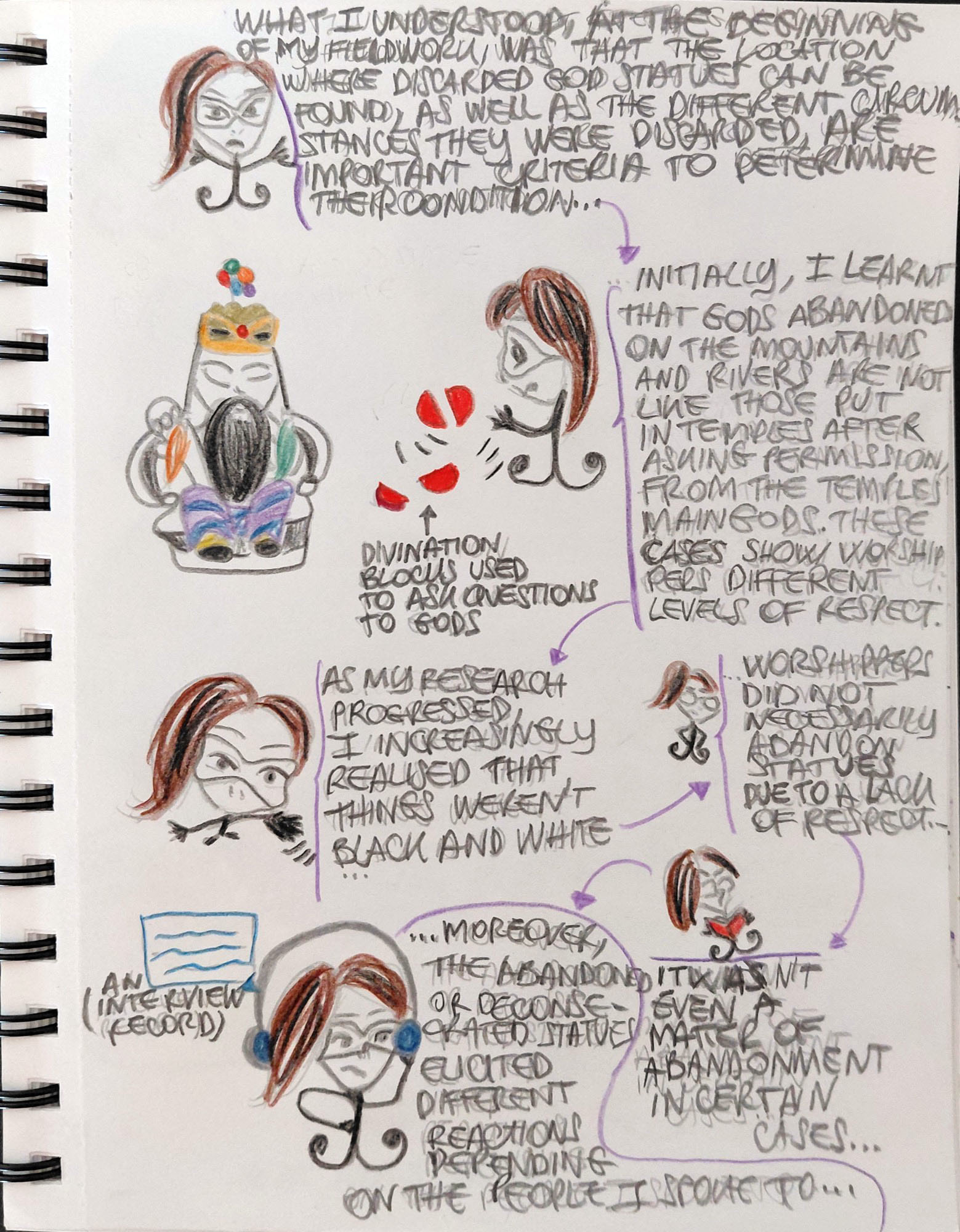
What I understood, at the beginning of my fieldwork, was that the location where discarded god statues can be found, as well as the different circumstances they were discarded, are important criteria to determine their condition… Initially, I learnt that gods abandoned on the mountains and rivers are not like those put in temples after asking permission from the temples’ main gods. These cases show worshippers’ different levels of respect. As my research progressed, I increasingly realised that things were not black and white… …Worshippers did not necessarily abandon statues due to a lack of respect. It wasn’t even a matter of abandonment in certain cases… …Moreover, the abandoned or deconsecrated statues elicited different reactions depending on the people I spoke to…(an interview record)
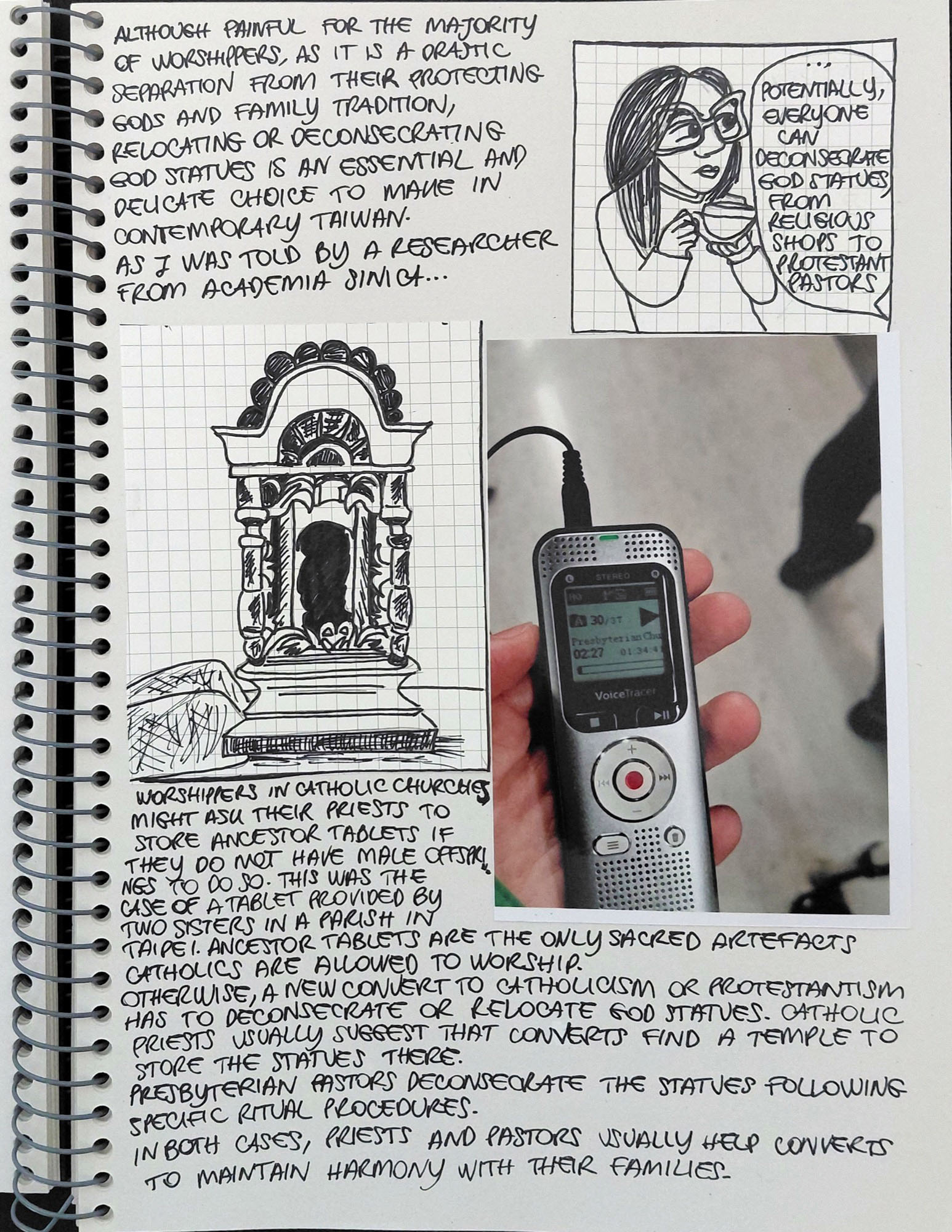
Although painful for the majority of worshippers, as it is drastic separation from their protecting gods and family tradition, relocating or deconsecrating god statues is an essential and delicate choice to make in contemporary Taiwan. As I was told by a researcher from Academia Sinica… “…Potentially, everyone can deconsecrate god statues, from religious shops to Protestant pastors.”
Worshippers in Catholic churches might ask their priests to store ancestor tablets if they do not have male offsprings to do so. This was the case of a tablet provided by two sisters in a parish in Taipei. Ancestor tablets are the only sacred artefacts Catholics are allowed to worship. Otherwise, a new convert to Catholicism or Protestantism has to deconsecrate or relocate god statues. Catholic priests usually suggest that converts find a temple to store the statues there. Presbyterian pastors deconsecrate the statues following specific ritual procedures. In both cases, priests and pastors usually help converts to maintain harmony with their families.
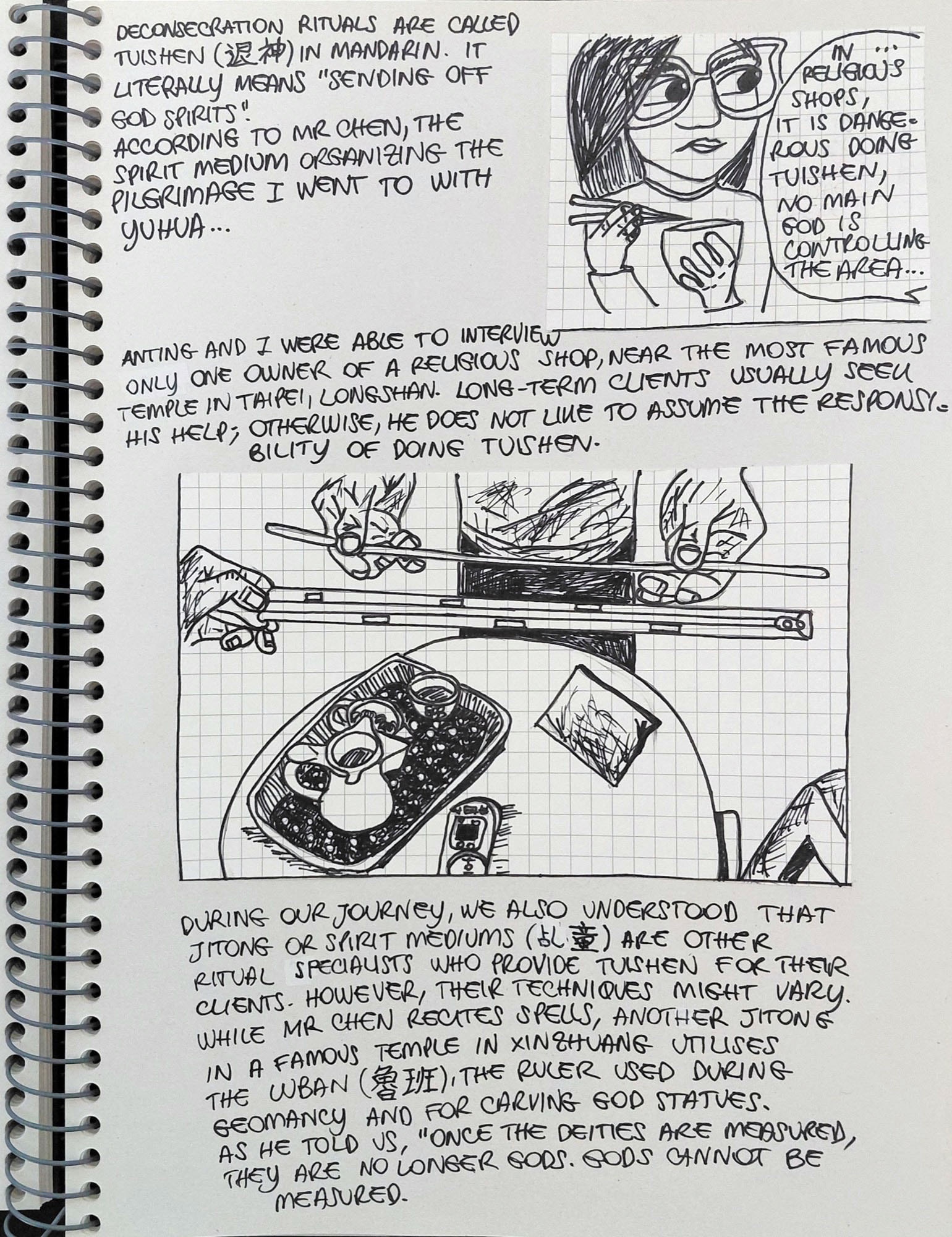
Deconsecration rituals are called tuishen (退神) in Mandarin. It literally means “sending off god spirits.” According to Mr Chen, the spirit medium organizing the pilgrimage I went to with Yuhua… “…In religious shop, it is dangerous doing tuishen, no main god is controlling the area…”
Anting and I were able to interview only one owner of a religious shop, near the most famous temple in Taipei, Longshan. Long-term clients usually seek his help; otherwise, he does not like to assume the responsibility of doing tuishen.
During our journey, we also understood that tongji or spirit medium (童乩) are other ritual specialists who provide tuishen for their clients. However, their techniques might vary. While Mr Chen recites spells, another Tongji in a famous temple in Xinzhuang utilizes the Luban (魯班), the ruler used during geomancy and for carving god statues. As he told us, “Once they deities are measured, they are no longer gods. Gods cannot be measured.”
The people we talked with usually confirmed Mr Chen’s statement. Temples are considered the safest places where tuishen can be performed. Temples might also welcome statues from other temples that closed down, providing them with worship.
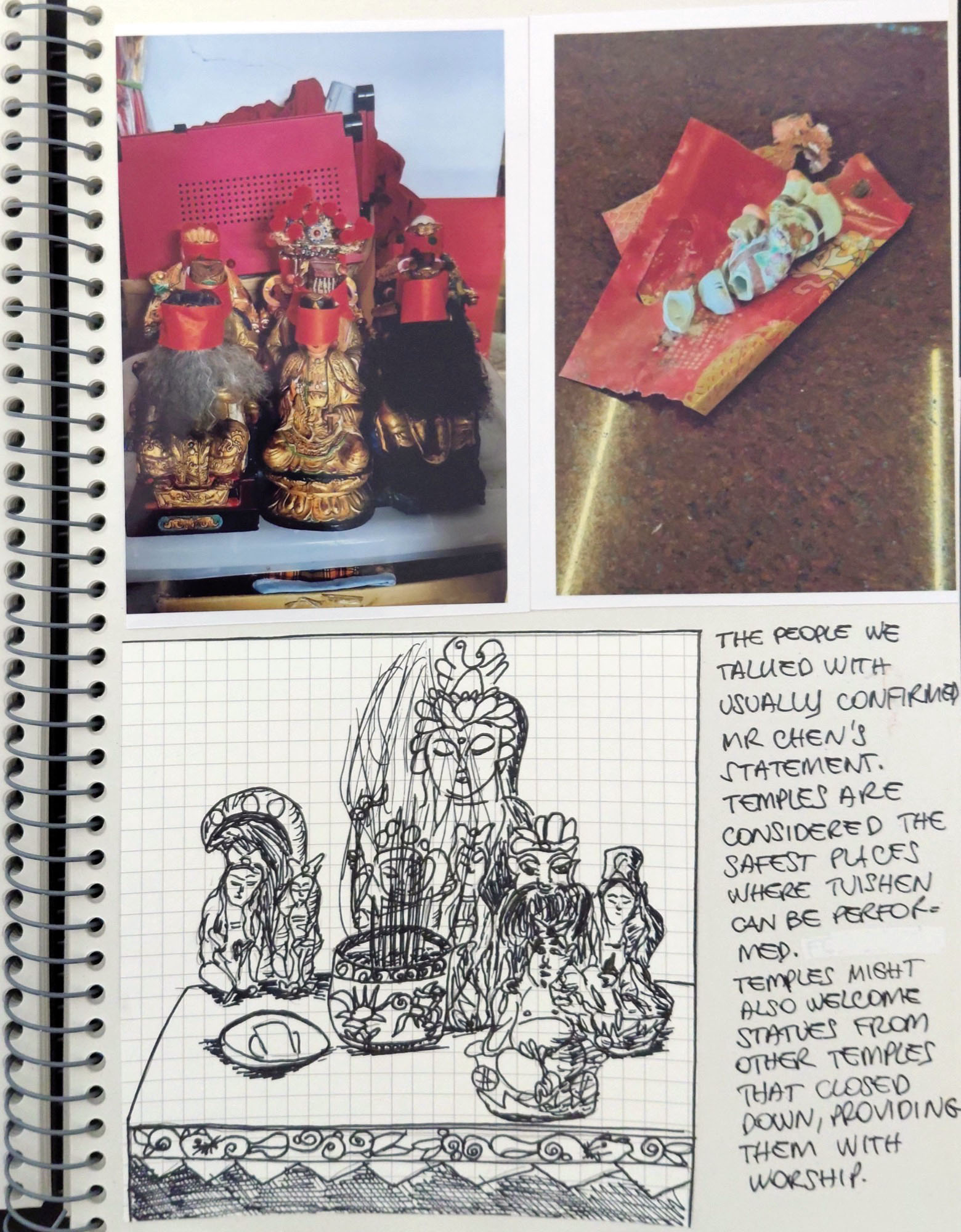
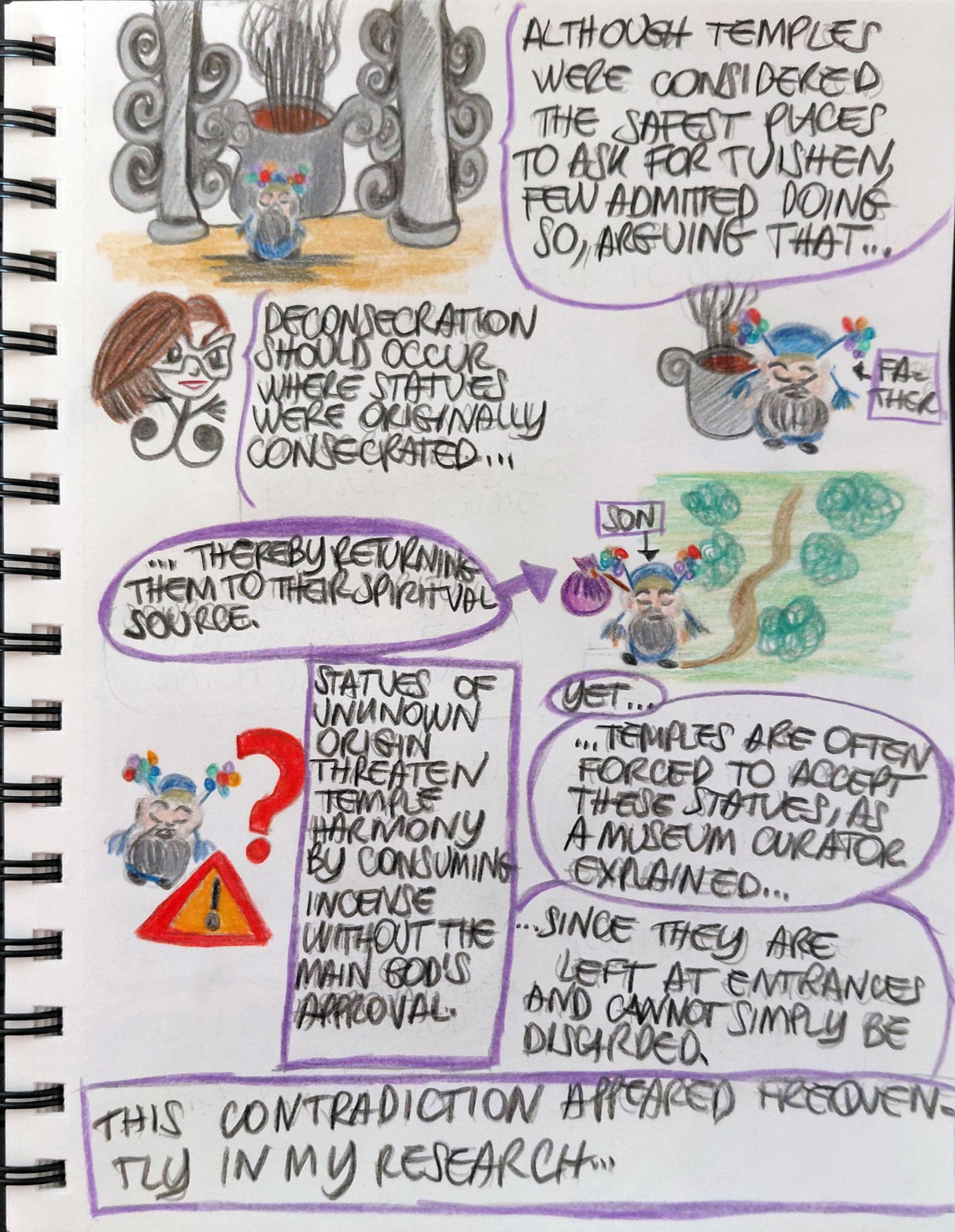
Although temples were considered the safest places to ask for tuishen, few admitted doing so, arguing that deconsecration should occur where statues were originally consecrated, thereby returning them to their spiritual source. Statues of unknown origin threaten temple harmony by consuming incense without the main god’s approval. Yet, temples are often forced to accept these statues, as a museum curator explained, since they are left at entrances and cannot simply be discarded. This contradiction appeared frequently in my research…
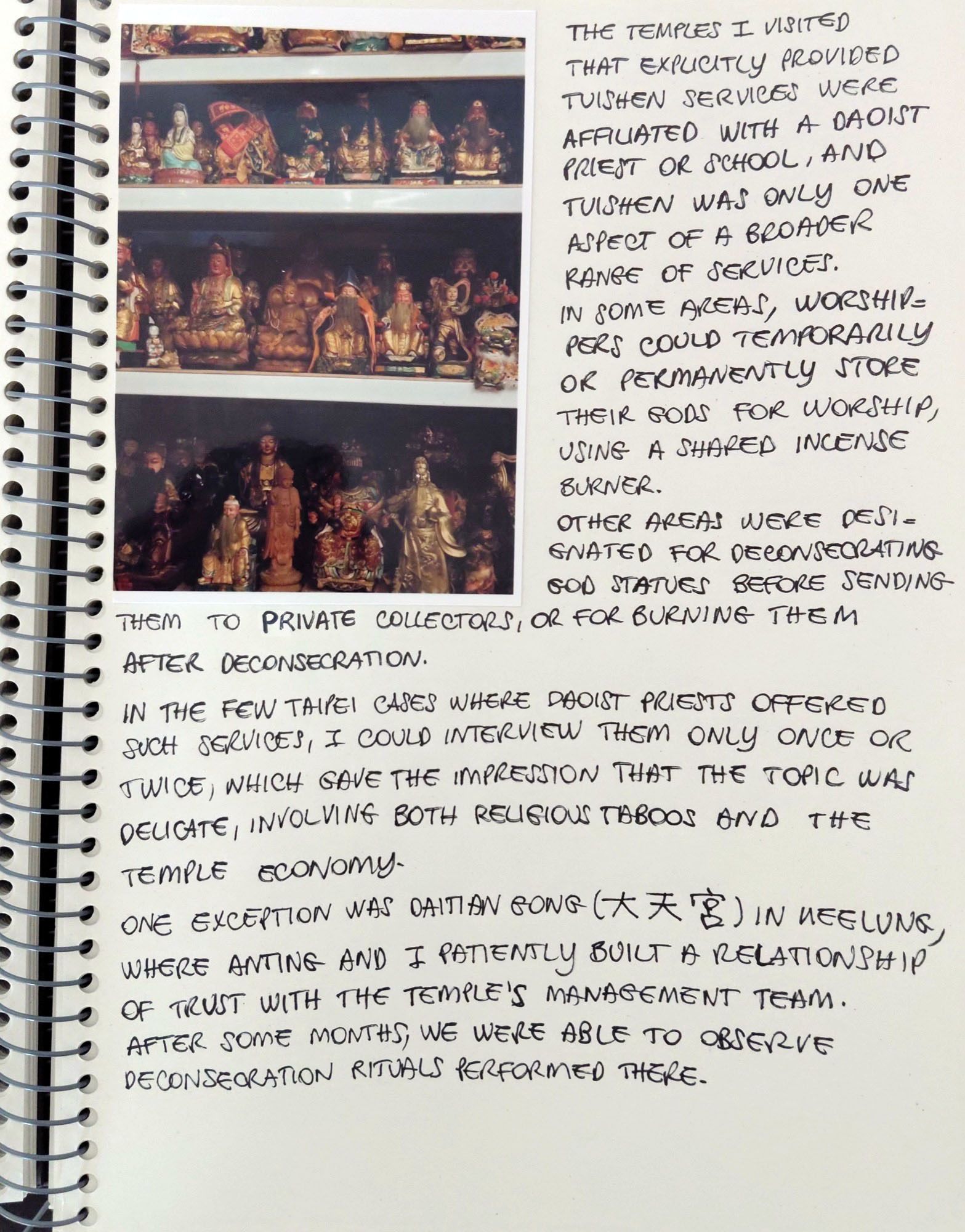
The temples I visited that explicitly provided tuishen services were affiliated with a Daoist priest or school, and tuishen was only one aspect of a broader range of services. In some areas, worshippers could temporarily or permanently store their gods for worship, using a shared incense burner. Other areas were designated for deconsecrating god statues before sending them to private collectors, or for burning them after deconsecration. In the few Taipei cases where Daoist priests offered such services, I could interview them only once or twice, which gave the impression that the topic was delicate, involving both religious taboos and the temple economy. One exception was Daitian Gong (代天宮) in Keelung, where Anting and I patiently built a relationship of trust with the temple’s management team and, after some months, we were able to observe deconsecration rituals performed there.
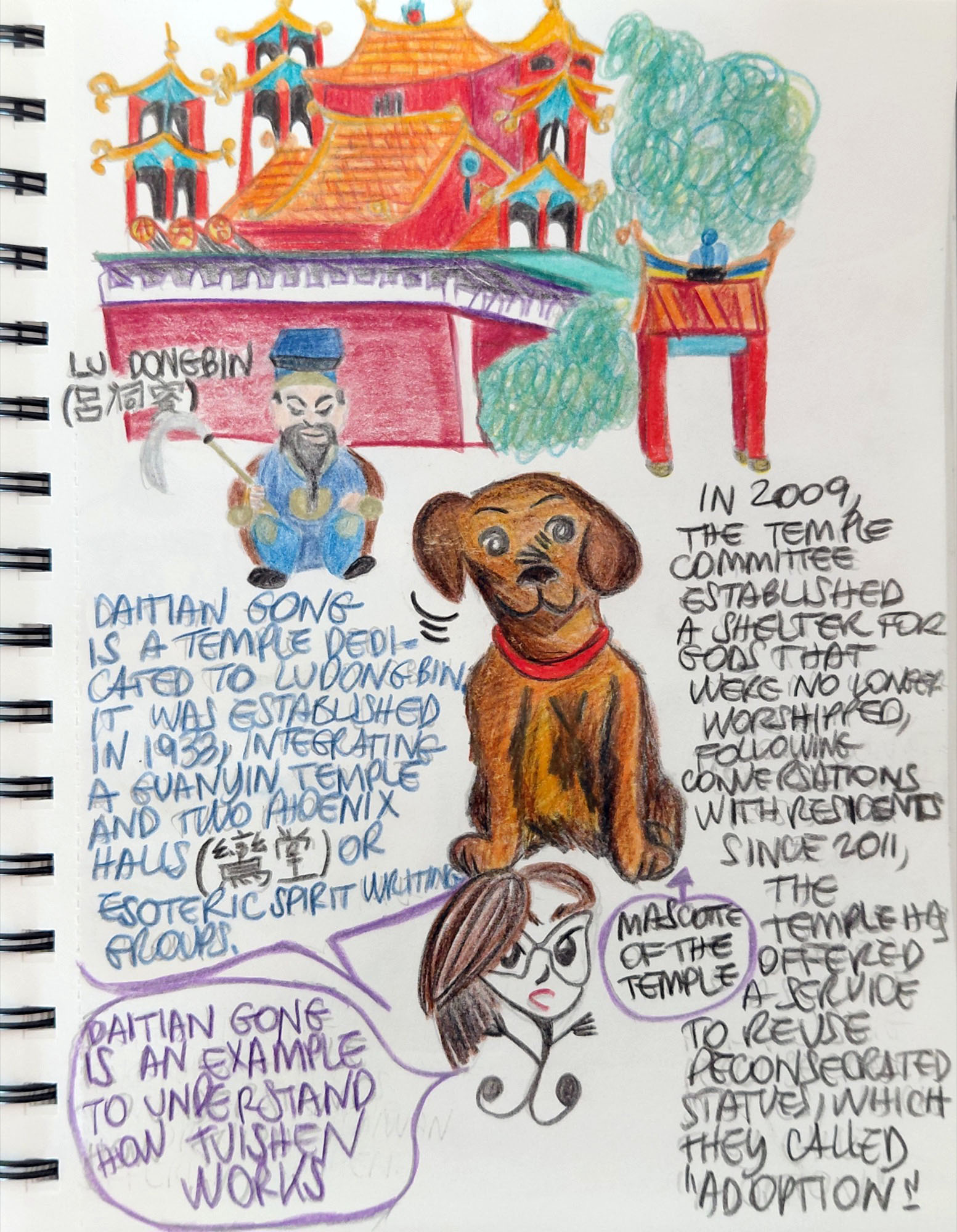
Daitian Gong is a temple dedicated to Lu Dongbin (呂洞賓). It was established in 1933, integrating a Guanyin temple with two Phoenix Halls (鸞堂), which are esoteric spirit writing groups. In 2009, the temple committee established a shelter for gods that were no longer worshipped following conversations with residents. Since 2011, the temple has offered a service to reuse deconsecrated statues, which they call “adoption.” Daitian Gong is an example to understand how tuishen works. (Mascotte of the temple)
The rituals for tuishen in Daitian Gong, as well as for temporary and permanent shelter, follow a defined sequence. First, worshippers and their families sign a contract for the service. Next, they bring their statues to the temple. There is then a ceremony, resembling a pilgrimage, in which the temple’s main god hosts a visiting god. Volunteers pass the statue through the temple incense burner, then place it on the main altar.
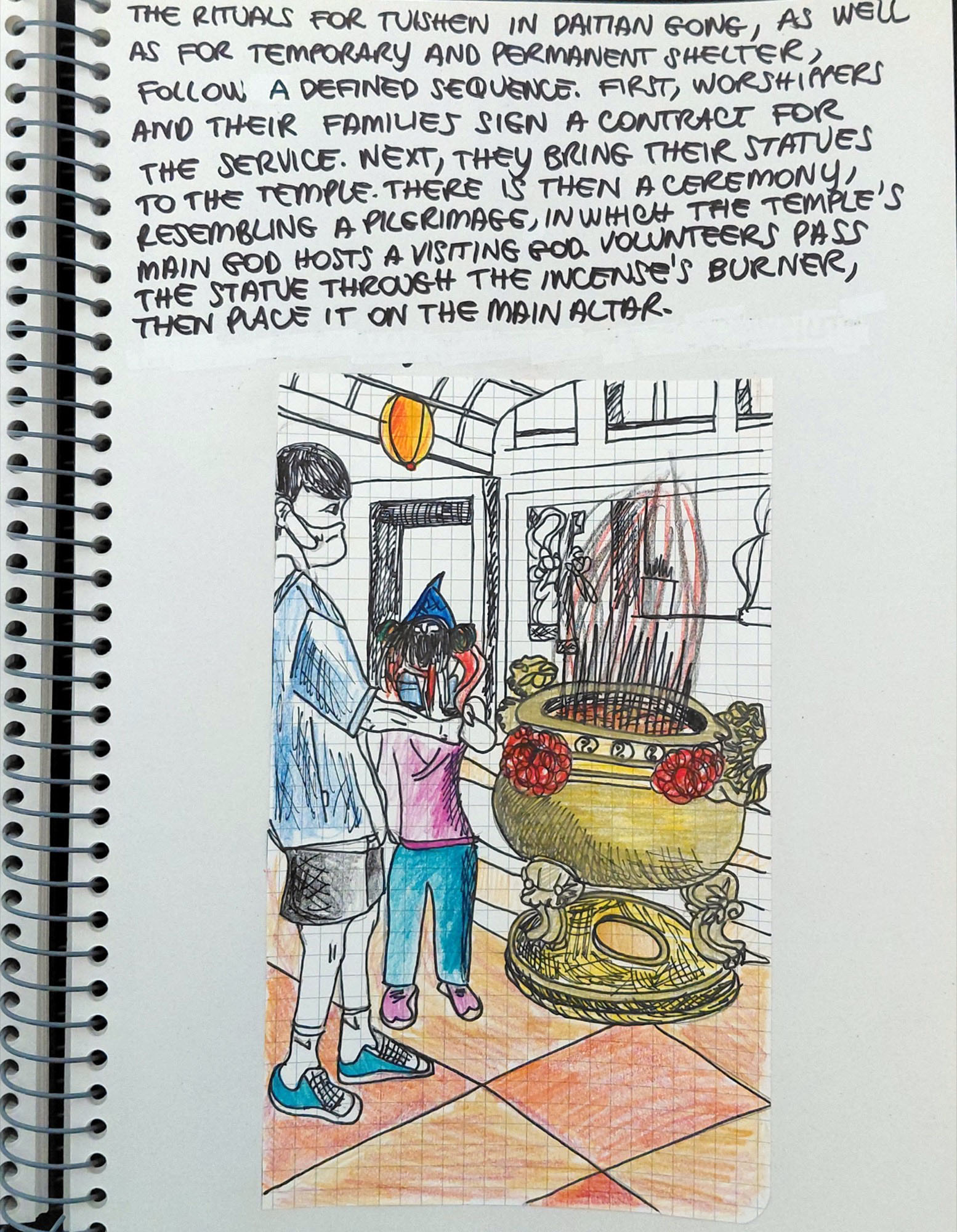
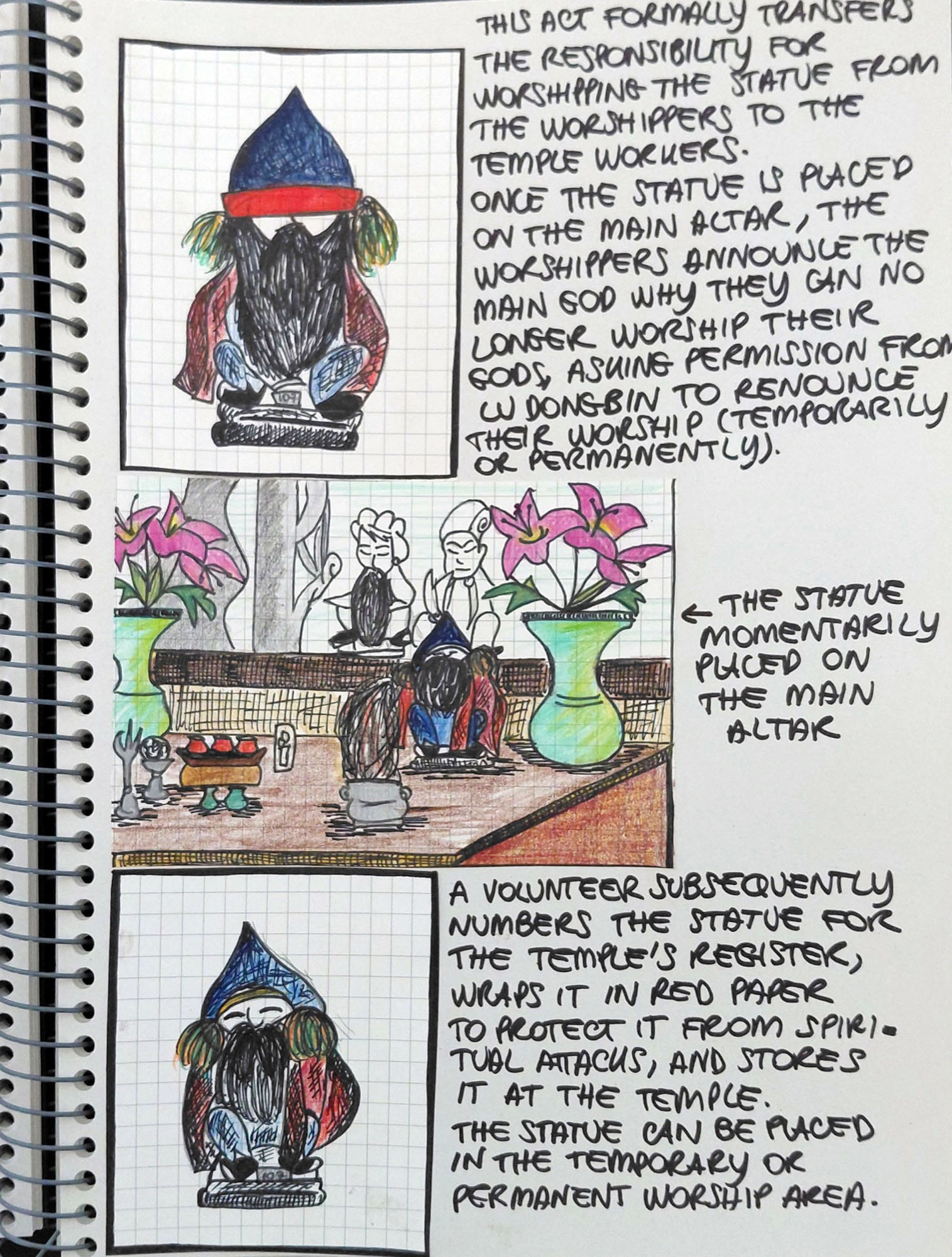
This act formally transfers the responsibility for worshipping the statue from the worshippers to the temple workers.
Once the statue is placed on the main altar, the worshippers announce to the main god why they can no longer worship their gods, asking permission from Lu Dongbin to renounce their worship (temporarily or permanently). A volunteer subsequently numbers the statue for the temple’s register, wraps it in red paper to protect it from spiritual attacks, and stores it at the temple. The statue can be placed in the temporary or permanent worship area.
If the temple management considers it precious, it is moved to the exhibition area as a cultural relic after deconsecration. Statues in either place display a golden plate with provenance details. Deconsecrated statues not used for these purposes may be given to worshippers or collectors through an adoption ceremony, or, if too common or damaged, may be burned instead.

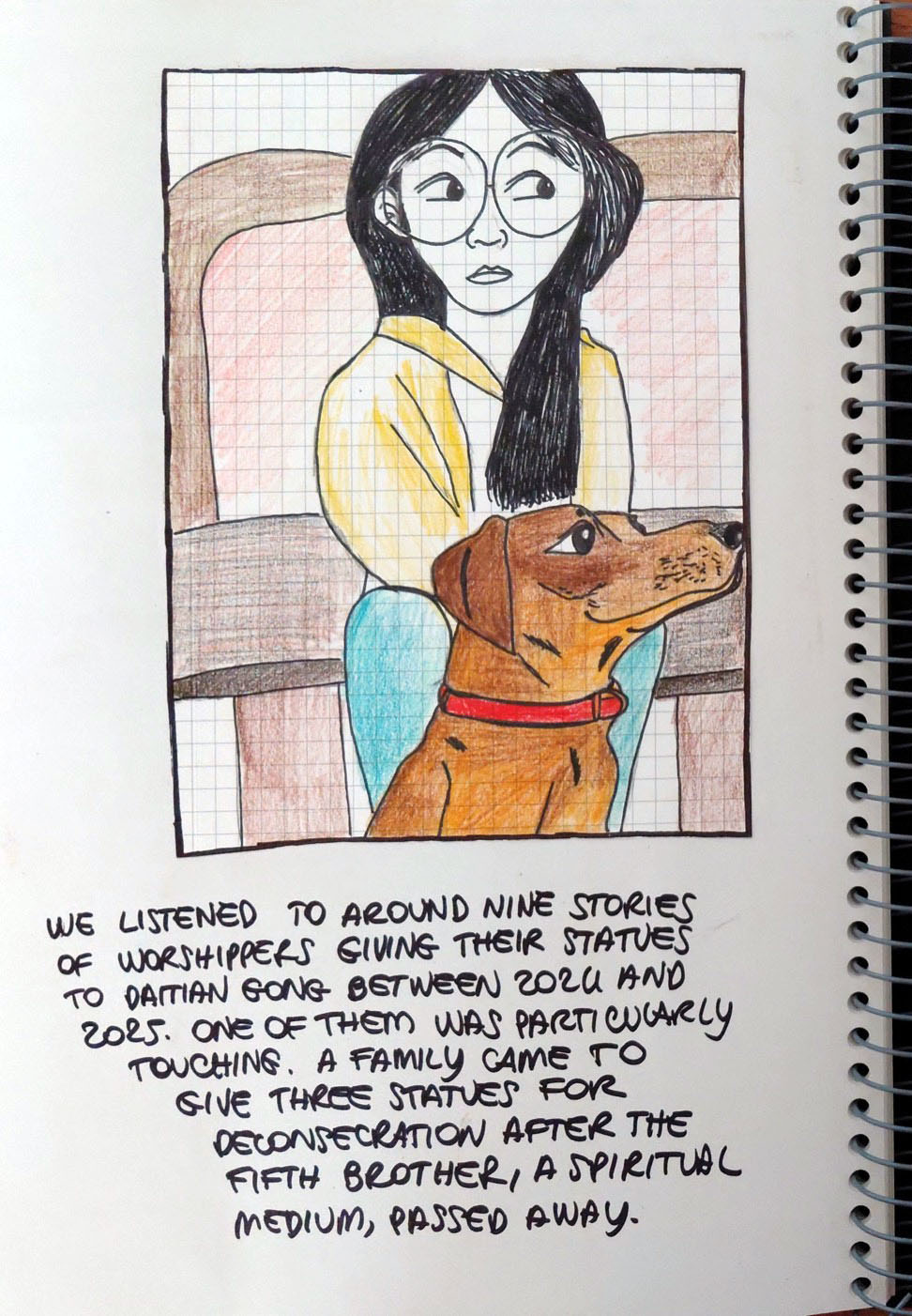
We listened to around nine stories of worshippers giving their statues to Daitian Gong between 2024 and 2025. One of them was particularly touching. A family came to give three statues for deconsecration after the fifth brother, a spiritual medium, passed away.
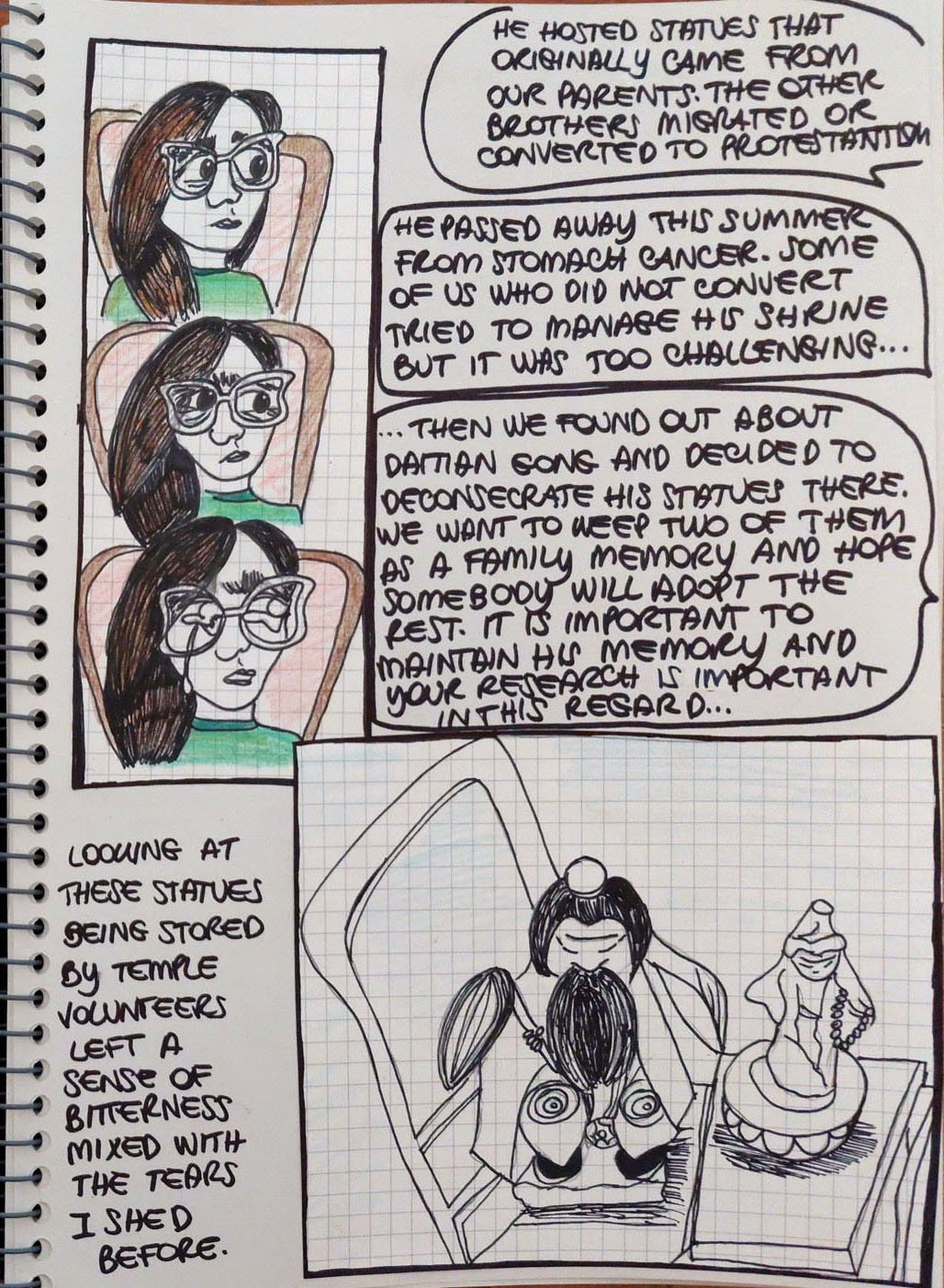
“He hosted statues that originally came from our parents. The other brothers migrated or converted to Protestantism.” “He passed away this summer from stomach cancer. Some of us who did not convert tried to manage his shrine, but it was too challenging…” “…Then we found out about Daitian Gong and decided to deconsecrate his statues there. We want to keep two of them as a family memory and hope somebody will adopt the rest. It is important to maintain his memory and your research is important in this regard…” Looking at these statues being stored by temple volunteers left a sense of bitterness mixed with the tears I shed before.
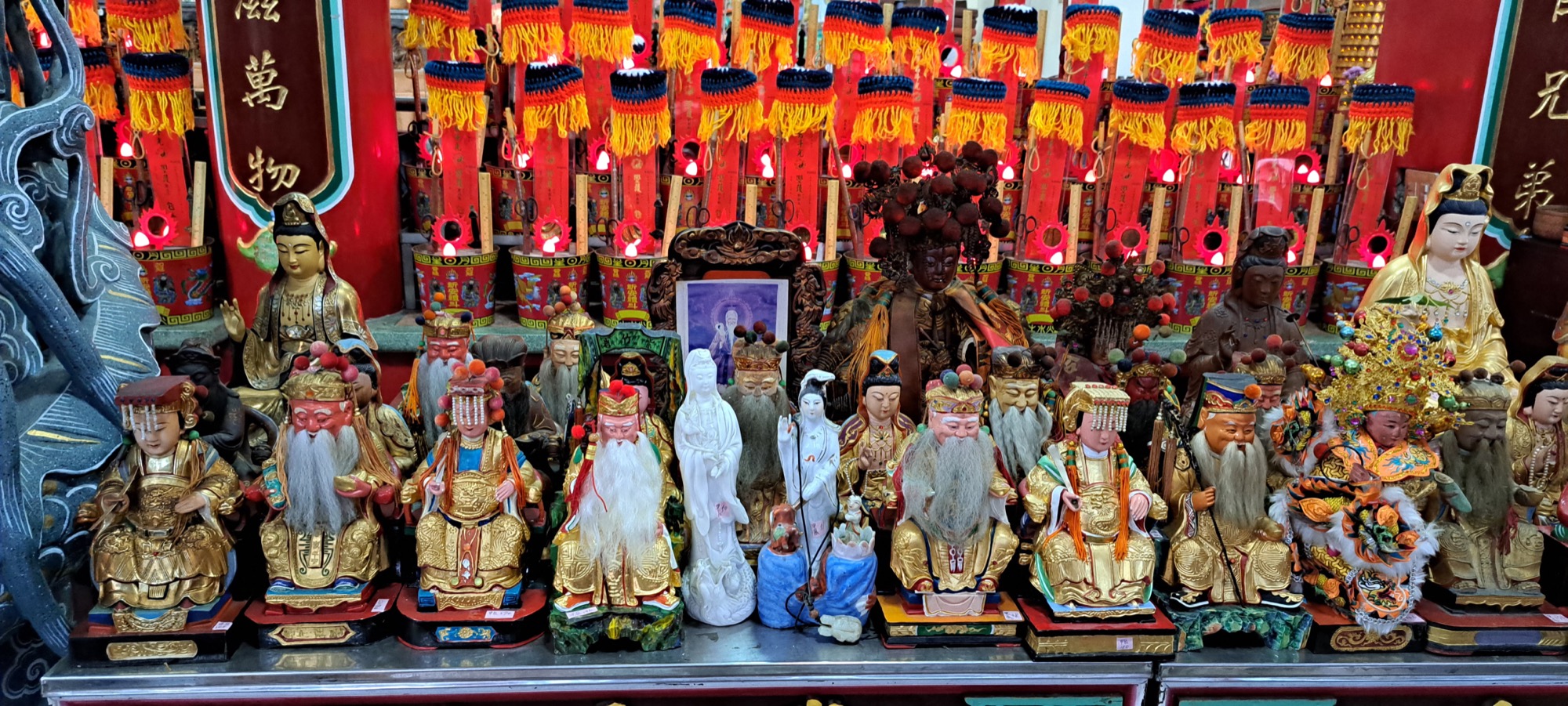
In Daitian Gong, as well as other public temples providing tuishen, tuishen is performed in coincidence with the preparatory days of the Chinese New Year, in particular with the ceremony of sending off the gods or song shen (送神), when the main gods worshipped by people are sent back to heaven to report to the Jade Emperor, the highest-rank god in the Daoist pantheon, worshippers’ transgressions and good deeds. After the ceremony, temple members and families thoroughly clean their altars and the gods’ statues. Within this context, tuishen is therefore a ritual of purification and conclusion of the year. In other circumstances, tuishen is performed during auspicious days established by the Daoist priest or other ritual specialist offering the service and according to the worshippers’ date of birth.
The Daoist priest and his fellow helpers invite all the gods of the Daoist pantheon, as well as gods from nearby temples, to be present at the ceremony, agree upon and certify it. Through petitions and spells recitations, the Daoist priest thank all the gods for their help for worshippers and the impossibility to worship them any longer, asking to go back to the heaven, cultivate themselves at the temple or becoming spirit soldiers for the temple, depending from their hierarchy. According to other Daoist priests we interviewed, tuishen should be considered a ceremony in which gratefulness towards gods and sincere intentions are communicated before asking gods to leave the statues.
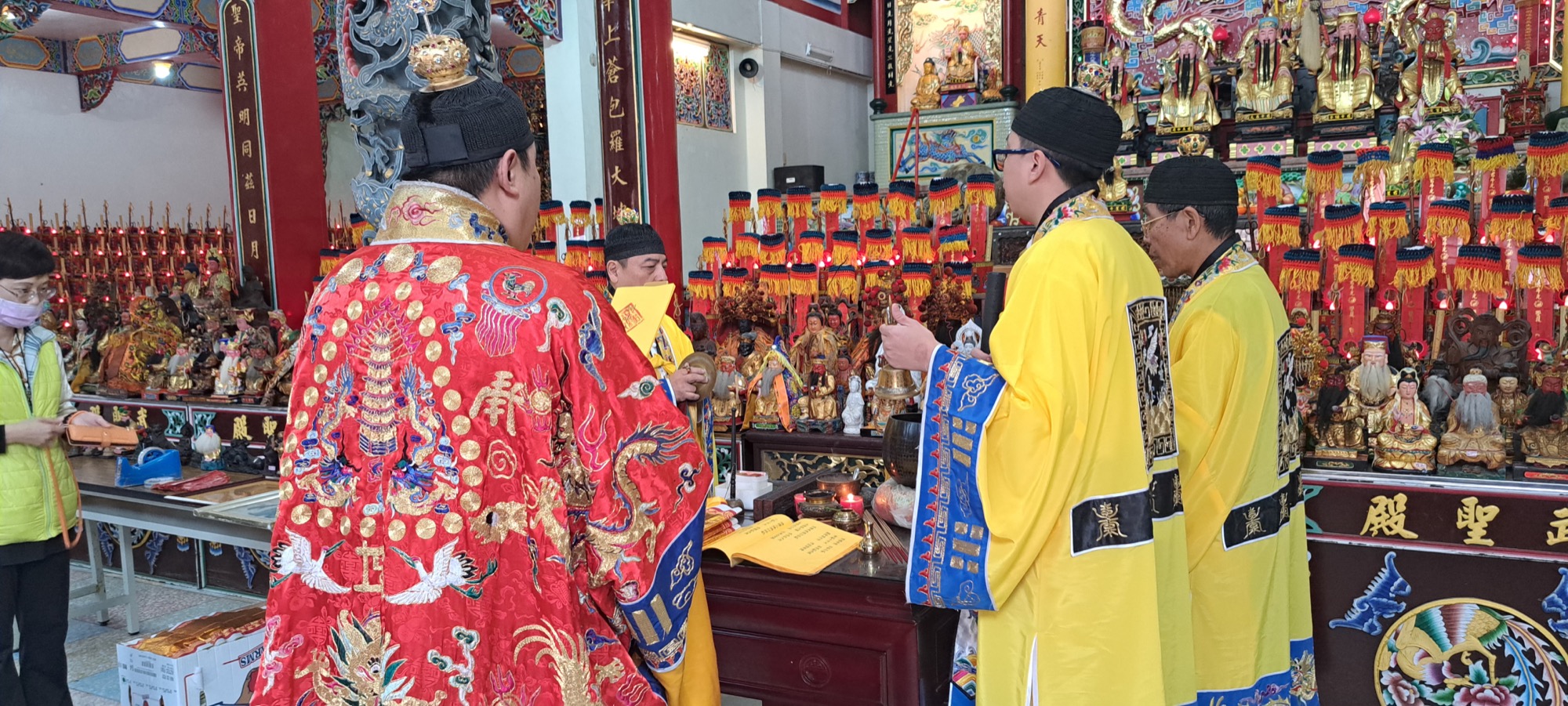

After these recitations, each Daoist priest present at Daitian Gong individually asks each god to leave its statue.
Paper money is subsequently burnt to conclude the request, whilst the god statues’ eyes are covered by red paper. Any trace on the statues’ backs reporting the identity of the previous worshipper is removed to prepare the statues for adoption. It is the duty of the adopter to commission a Daoist priest or another ritual specialist to reconsecrate the statue. As already mentioned, statues that are not considered adoptable are burned. Burning deconsecrated statues is often seen as the only way to prevent the gods’ spirits from lingering.
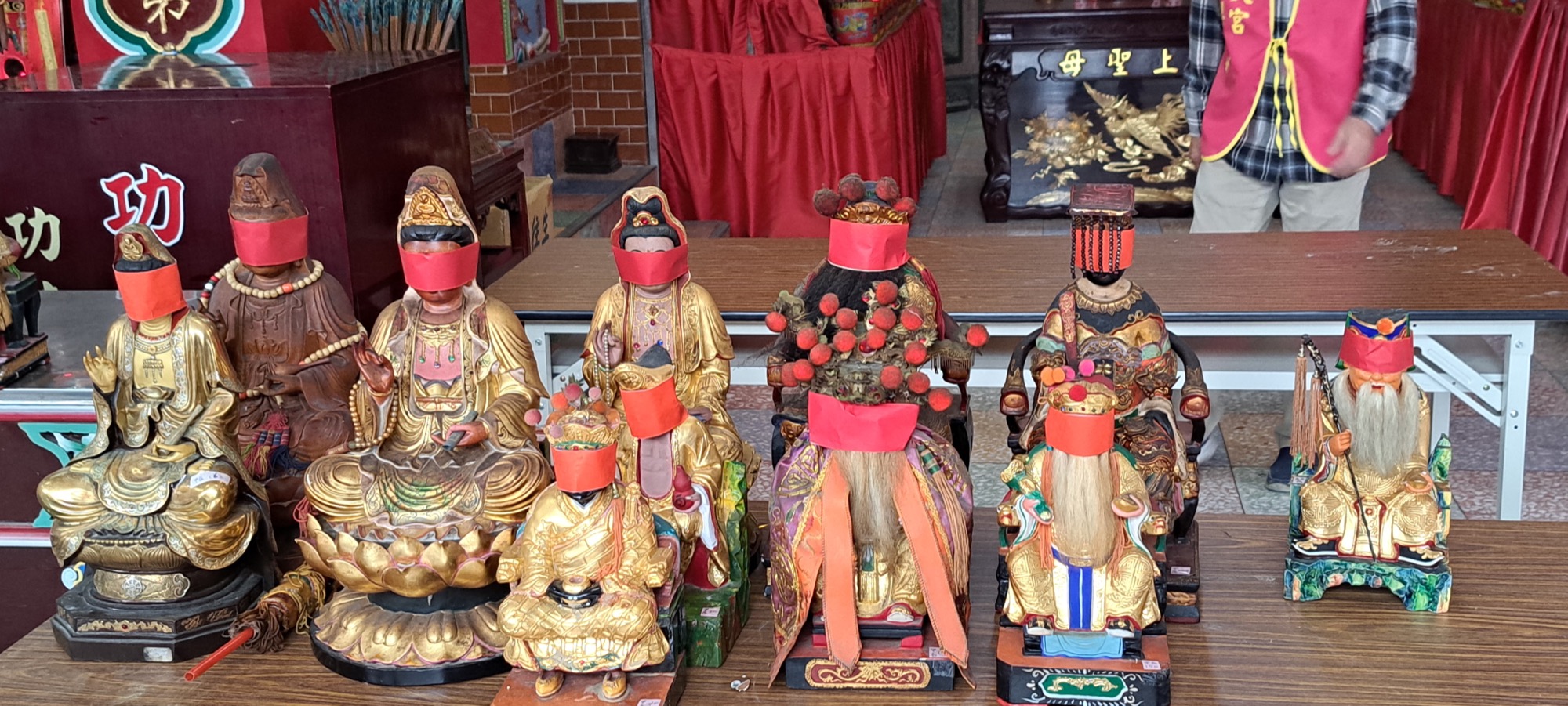
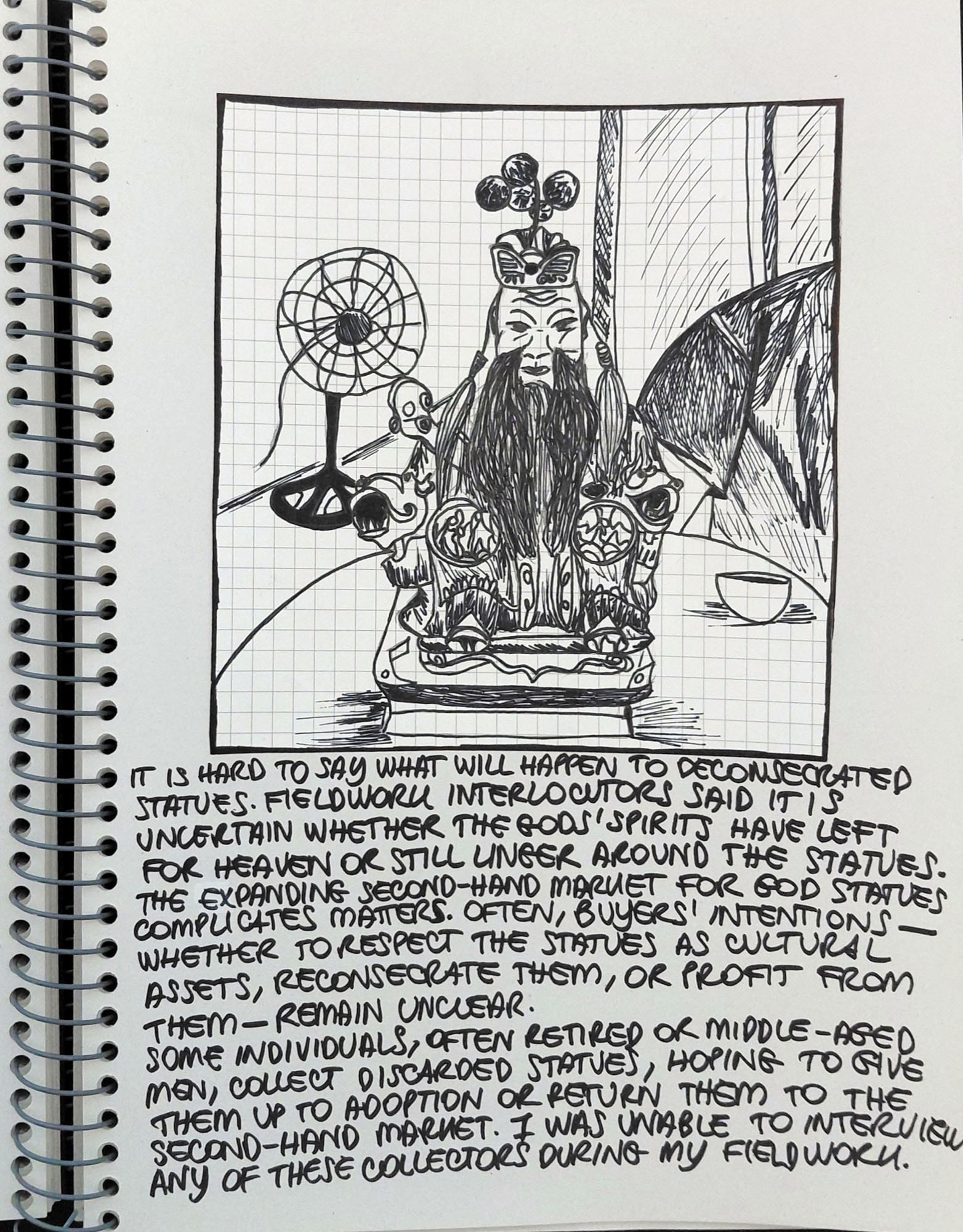
It is hard to say what will happen to deconsecrated statues. Fieldwork interlocutors said it is uncertain whether the gods’ spirits have left for heaven or still linger around the statues. The opaque, expanding second-hand market for god statues complicates matters. Often, buyers’ intentions—whether to respect the statues as cultural assets, reconsecrate them, or profit from them—remain unclear. Some individuals, often retired or middle-aged men, collect discarded statues, hoping to give them up for adoption or return them to the second-hand market. I was unable to interview any of these collectors during my fieldwork.
As it is controversial for worshippers to request deconsecration, it is also contentious to acquire, collect or reconsecrate a deconsecrated statue. There is no assurance that the spirit has vacated the statue. Some people are not worried about these statues; others feel uncomfortable. To gain further insight, I asked contemporary artist Hung-Chih Peng about his experience of collecting statues. If interested, follow Hung-Chih Peng section.

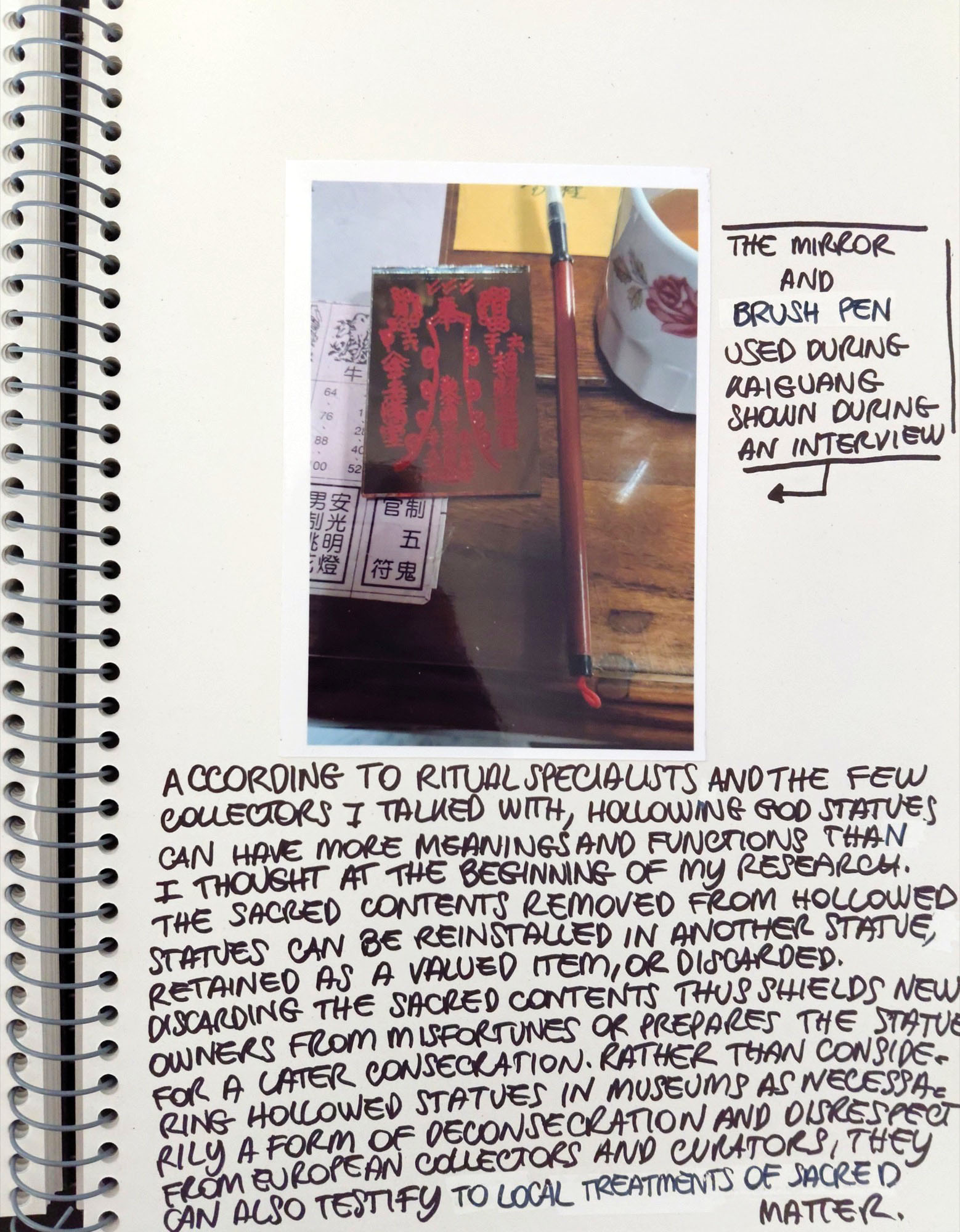
According to ritual specialists and the few collectors I talked with, hollowing god statues can have more meanings and functions than I thought at the beginning of my research. The sacred contents removed from hollowed statues can be reinstalled in another statue, retained as a valued item, or discarded. Discarding the sacred contents thus shields new owners from misfortune or prepares the statue for a later consecration. Rather than considering hollowed statues in museums as necessarily a form of deconsecration and disrespect from European collectors and curators, they can also testify to local treatments of sacred matter. (The mirror and brush pen used during kaiguang provided during an interview)
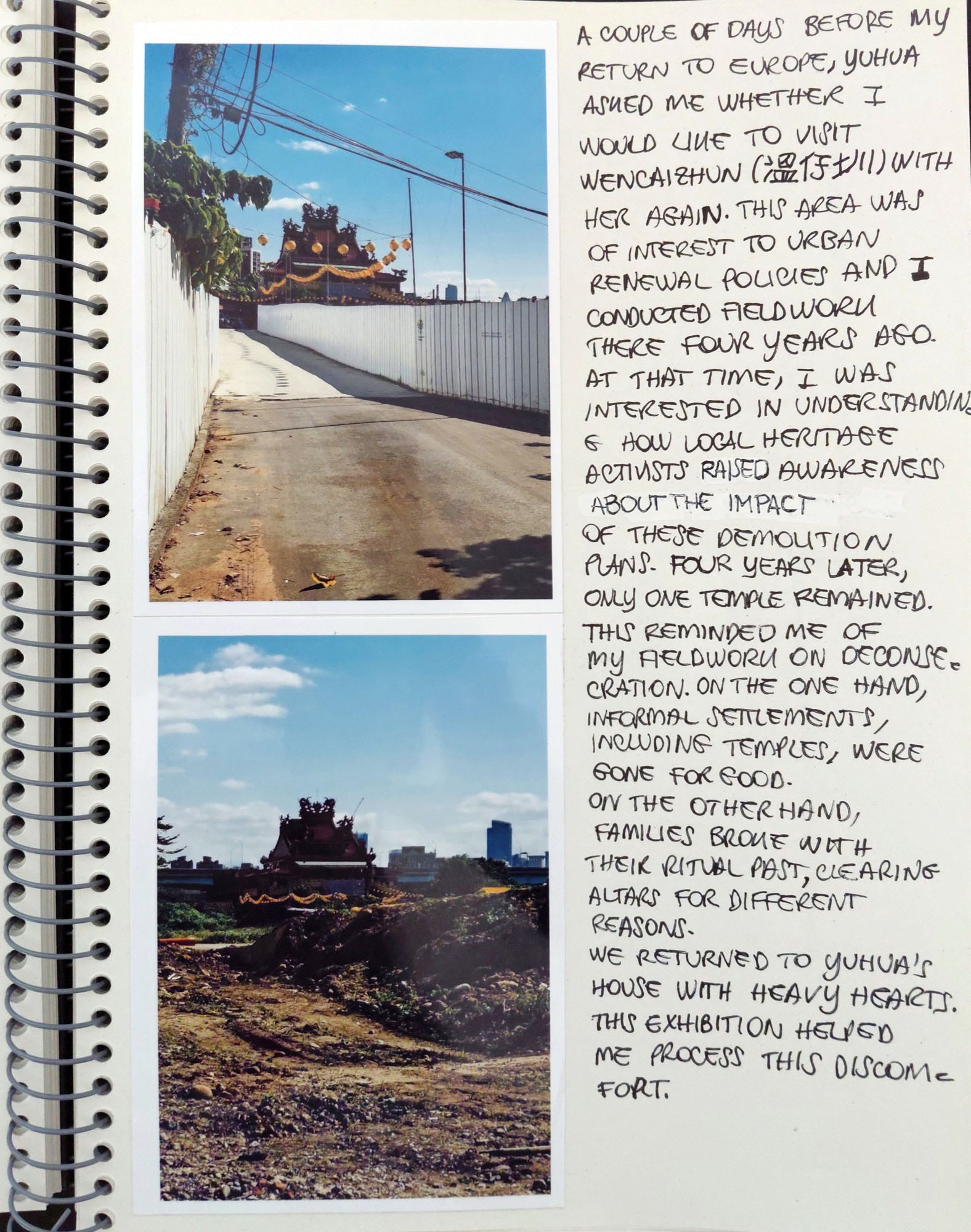
A couple of days before my return to Europe, Yuhua asked me whether I would like to visit Wencaizhun (溫仔圳) with her again. This area was of interest to urban renewal policies and I conducted fieldwork there four years ago. At that time, I was interested in understanding how local heritage activists raised awareness about the impact of these demolition plans. Four years after, only one temple remained. This reminded me of my fieldwork on deconsecration. On the one hand, informal settlements, including temples, were gone for good. On the other hand, families broke with their ritual past, clearing their altars for various reasons. We returned to Yuhua’s house with heavy hearts. This exhibition helped me process this sense of discomfort.
The end
Conclusions

I began my research journey to answer a central question: how should deconsecrated Chinese folk god statues be appropriately treated in museums, especially when their histories are obscured and their handling raises religious and ethical concerns? While archival research uncovered different collectors’ approaches to these statues in the 20th century—a Catholic missionary congregation and a Protestant pastor—reconstructing the full story of the two statues I encountered in Italian and German museums remained impossible. Ethnography in Taiwan also showed how contradictory good curatorial practices are: if this research was necessary for “museum curators”, it was also a delicate process that touched on religious taboos, controversial historical periods such as the Lottery Era, and family stories, thereby making the ethnographer’s position in the field troubling.
Taiwanese museums still collect statues from worshippers as part of the island’s religious heritage. At the Tudigong Culture Museum in Taoyuan, these artefacts were donated by worshippers who could no longer keep their statues. A Daoist priest deconsecrated these statues and suggested preventive measures, such as putting red paper around statues’ eyes or inserting paper money around the statues and their clothing.
Yet, as many fieldwork companions noted, there is no set way to handle deconsecrated god statues. So, deciding how Chinese folk god statues should be treated in European museums must be decided on a case-by-case basis, recognizing that no single method reflects all Chinese folk believers’ views and feelings.
In conclusion, the audience will leave this exhibition with more questions than answers. “Traces of Guanyin”, if anything, teaches how it is important to feel awkward towards museum collections. It is from this uncomfortable position that a balance between different positions and the presence of silenced stories becomes possible.
