When did you start to be interested in god statues?
I believe it was around 2006 when I first became interested in this subject. At the time, I was preparing for a solo exhibition and was searching for a theme. During a conversation with a friend, he mentioned the phenomenon of “abandoned deities”. That moment sparked my curiosity, and I began researching the topic online.
*Click on the first image to open the photo gallery .


Why did you decide to focus on abandoned statues, given how they are associated with taboos?
To me, these deities reflect a serious and often overlooked social condition. Many of these gods were abandoned because they were believed to be ineffective or no longer “spiritually responsive.” Especially during the 1980s and 1990s, when Taiwan experienced a wave of underground gambling related to the lottery, deities who failed to provide lucky numbers were punished—beheaded, dismembered, or burned, as a form of retribution. They were not just abandoned but marked as omens of misfortune, feared and rejected by all.
How did you perceive these statues before starting this artistic project?
At first, I approached these statues as art objects, reflecting on the systems of cultural production. Most of them were exquisitely crafted, primarily from wood. One can imagine the number of artisans—woodcarvers, painters, gold leaf specialists—who labored over them. Their beards and hair were implanted strand by strand, and many were adorned with beads, textiles, and sacred robes. These figures embodied a vast traditional craft industry. That was my initial lens. But the more time I spent with them, the more I began to sense something else—something profoundly human, even spiritual. It felt as if each statue housed a soul, or at least carried the residue of human belief. Over time, I could no longer see them merely as objects or cultural artifacts. They became thresholds to another dimension, something beyond material or institutional presence.
What do you think about the abandonment of statues? Do you express any message within your artwork connected to this?
They reminded me of the stray dog crisis that once plagued Taiwan. These deities, once meant to reside in heaven, had been exiled to the earthly realm—now wandering, homeless, treated with the same neglect we often reserve for stray animals. Once divine, now forsaken, they inhabit a space between reverence and abandonment.


How did you conduct research on the collectors of these statues?
Initially, I had intended to focus on a temple in Sanjiaodu, Shilin District, which had a unique architectural mechanism to protect itself from flooding. When floodwaters approached, the entire temple could be elevated.
There were also a few abandoned statues there, and I considered centring the work on this temple. But aside from the temple’s vertical movement, abandoned deities were few, and the people who gathered at the temple were not comfortable talking with me.


Eventually, I discovered a man named Mr Lu in Emei, Hsinchu. Every morning, he would wake to find a long line of abandoned god statues waiting outside his doorstep, as if queuing for shelter. The number of statues in his care was astonishing—tens of thousands. They could no longer fit indoors, so many were moved to the surrounding hillside. Some were already reduced to dust by termites; others had weeds growing directly from their heads. When the accumulation became unmanageable, the statues were sometimes burned in mass cremations. Visually, the sheer quantity of these abandoned deities was overwhelming.
The visual impact was so powerful that I felt no other site could compare in scale or atmosphere. Mr Lu was also very open and welcoming—he actively encouraged people to take the statues away. It felt like the perfect match for my project. In this context, Mr Lu seemed to embody the role of a living tongji—a spirit medium. It was summer at the time. He wore only a pair of shorts; his skin was darkened by the sun, and his eyes gleamed with intensity. His voice was deep and resonant, his body radiated a reddish hue—as if he himself had become a living statue, an embodied effigy of spiritual force. The arrangement of objects in the rightmost room bore a striking resemblance to the ritual layout of an active temple, suggesting a deliberate spatial logic of veneration. I seem to recall him mentioning that he had once served as a jitong, though I cannot say for certain. What he did say, however, was that all of the statues in his possession had been desacralized—ritually stripped of their divine presence.


Mr Lu’s site is remarkably extensive. The indoor area alone exceeds 50 pings (approximately 165 square meters), and behind it lies a sloped outdoor space of another 50 to 60 pings, roofless and exposed, filled with an overflow of religious statuary. In addition, across the street stands another building, its interior densely packed with discarded god statues—piled high in a manner evocative of refuse, as if forming a mountain of sacred debris. I decided to present them in the simplest way possible—by bringing them directly into the exhibition space, allowing their collective presence to speak for itself.
Based on initial observation, the total number of statues appears to be in the tens of thousands. According to Mr Lu, when the number becomes unmanageable, is sometimes compelled to burn 10,000 to 20,000 god statues at once. Within the more orderly indoor area, he displays only those statues he considers visually pleasing or socially acceptable—ones he hopes visitors might be willing to adopt and take away. The remainder, deemed unfit or excessive, are left outdoors, subjected to the elements, while those crammed inside the warehouse across the street form a chaotic mass, he no longer has the capacity to process. This spatial and affective arrangement immediately brought to mind a visit I once made to a stray dog shelter in Tamsui. There, too, the more “adoptable” dogs were placed in the front section, where visitors could see them and possibly choose to bring one home. Toward the back, however, the shelter was subdivided into 20 or 30 enclosures, each housing dozens of dogs. The conditions were dire—overcrowded, filthy, and filled with the sound of constant barking and distress. The resemblance between these two sites—in both spatial logic and the implicit ethics of selection and abandonment—was striking and deeply unsettling.


Can you tell some stories of the statues, their biography?
Among the statues, the most common deities were Tudi Gong (the Earth God) and Guan Gong (Lord Guan). They are arguably the most widely worshipped figures in Taiwanese folk belief, so it made sense that they appeared in such large numbers. I approached them less from a theological angle, and more from a humanistic, almost anthropological perspective. I became particularly drawn to the damaged statues—the ones that bore visible signs of time and neglect. For instance, a Guan Gong whose hair had been blown into a wild afro by the wind; another whose beard had been eroded by sun and rain until only two strands remained, like dripping mucus. There was a Tudi Gong with his eyeballs gouged out, and a Guanyin whose body was half-burnt. These images, to me, felt like stories of human suffering—but performed by divine actors. They embodied the drama of worldly trials, cast in the forms of gods.
How do you contrast possible negative power from them?
The negative energy surrounding these statues was quite palpable when I first encountered them in Emei. There was a heaviness—a residue of fear, sorrow, or even resentment. But once they were installed within the gallery space, something changed. The menacing aura softened. It felt as if they were aware of being seen, regarded with dignity, no longer discarded. The gallery became a space of calm, even reconciliation, as if these spirits had been momentarily released from their grief.

What will the destiny of these statues be? How do you treat them now?
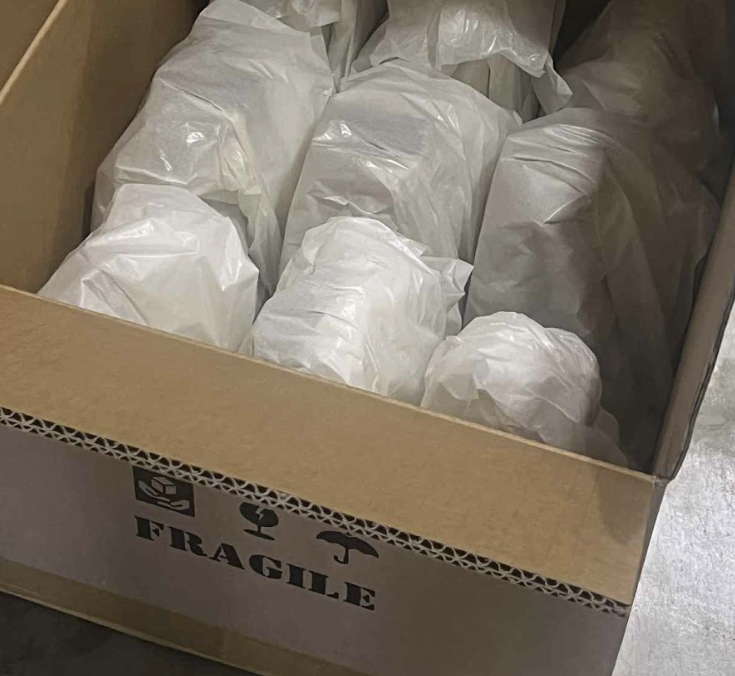
At one point, I used the entrance area of my studio as a display room for the deities, so that upon opening the door, hundreds of statues would immediately confront one, all gazing back at you. Installing them in this way—constructing shelves along the walls, arranging and aligning them—was a labour-intensive process, both physically and mentally demanding. Yet not long after the installation was complete, I found myself compelled to dismantle it. I packed the statues back into their boxes. Each time I opened the studio door, I felt as if a blade were thrusting toward me—a visceral reaction, accompanied by goosebumps and a subtle but growing sense of unease.
It felt as though the collective xiongqi—the fierce or aggressive energy of the statues—had been compressed into too small a space, intensifying their presence beyond what the room could hold. The atmosphere grew tense, discordant. For a studio, a space meant to foster creativity, a sense of harmony is essential. And so, the display was short-lived; the gods were returned to their temporary state of containment, stored in cardboard boxes.


However, I kept three of them in my studio: a Guanyin, a Xuantian Shangdi and Nezha. The Guayin was the one I found burnt and described to you previously. I selected these gods because of my connection to them. I have long felt a deep and personal connection to Guanyin, who has, in many ways, become a kind of protective deity for me. I vividly recall an experience during a guan luoyin ritual, in which I encountered Guanyin seated upon a dragon, guiding me toward the vision of my yuancheng gong—a palace of destiny in the spirit realm. The maternal aspect of Guanyin’s iconography resonates profoundly with me; perhaps it fills a certain emotional void left by the absence of maternal affection in my early life.
In addition to Guanyin, I have always been drawn to the figures of Xuantian Shangdi and Nezha. Both are frequently represented in strikingly beautiful sculptural forms—well-proportioned, aesthetically balanced, with piercing, vigilant gazes. I perceive their visual presence as powerful and protective.


For this reason, these three statues—Guanyin, Xuantian Shangdi, and Nezha—are placed on the highest shelf of my studio, where they seem to function not merely as decorative icons, but as silent guardians of the creative space. Today, half of the statues are part of the DSL Collection, a French contemporary art initiative. The other half, I am hoping, will eventually be acquired by a Taiwanese museum.