Whispers in museums
Dear visitors, have you ever imagined museum artefacts whispering to each other at night, when humans are not around? About what are they talking? Are they complaining about the treatment they received at their museums? Imagine that these conversations are between artefacts from two museums far from each other—the Museum of Chinese Art and Ethnography (Museo d’Arte Cinese ed Etnografico) of the Xaverian Missionary Institute in Parma and the Museum of Religions (Religionskundliche Sammlung) at Philipps-University Marburg. Two Chinese gods’ statues, a Guanyin and a Buddha, both have a hole on their backs. Upon the suggestion of common acquaintances among European Chinese collections, they began to communicate with each other in a language that humans can only detect as imperceptible reverberations surfacing on their intuition when they encounter material artefacts. The Guanyin and Buddha compare their stories and reflect on the presence of the holes in them. I am unsure, dear audience, whether I deciphered their chat correctly, but it seemed to me—the first time I could handle them in the presence of a museum curator or conservator—that they could introduce us to their stories and the gaps that I found in the archival material.
*Click on the first image to open the photo gallery and read the captions.

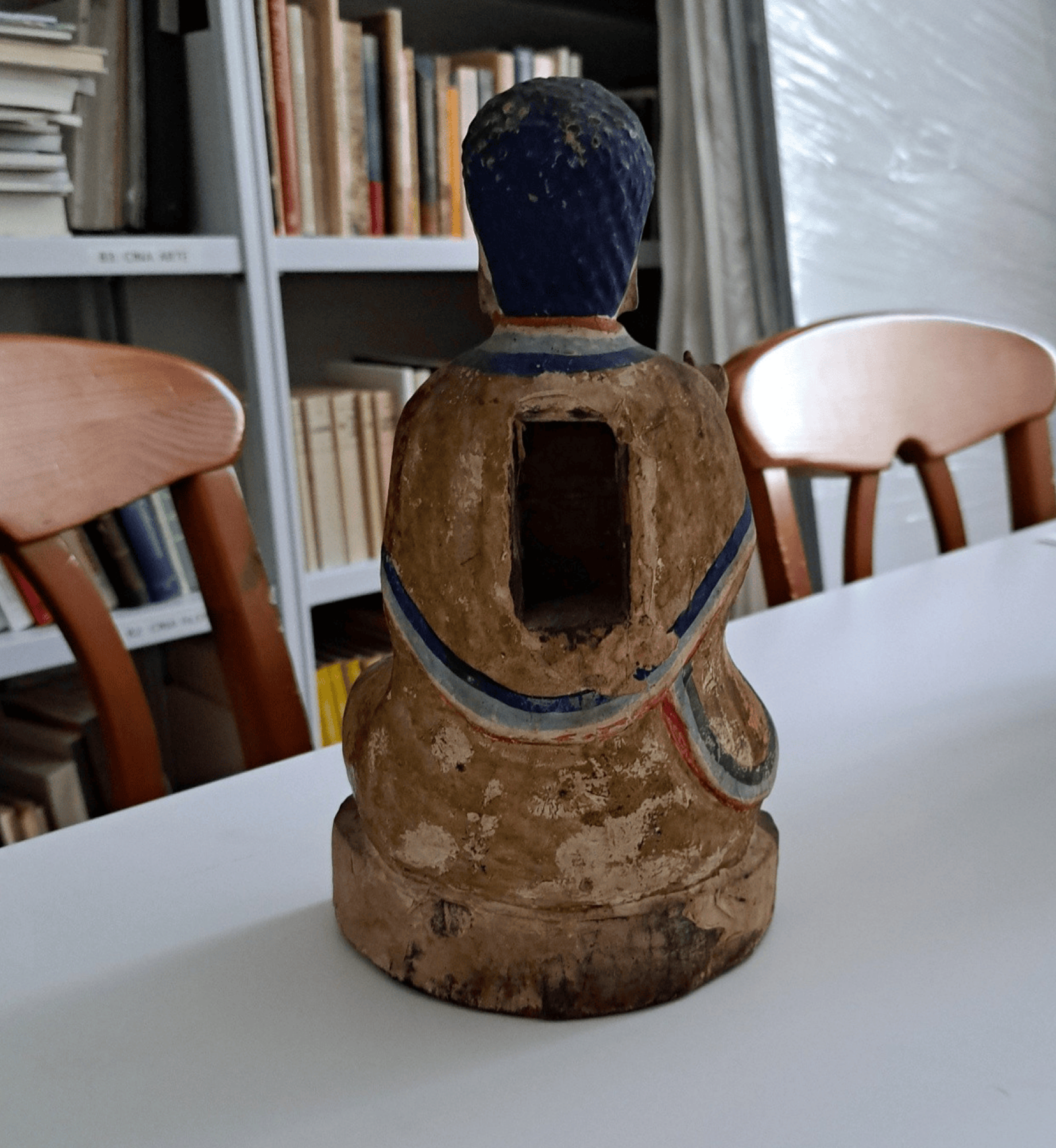
“This is Buddha speaking *. I came to this museum as a purchase from Monsignor Luigi Calza (1879-1944), Prefect and Vice Vicar in China and Xaverian missionary. I was taken together with other wooden statues when Calza returned to Italy to be ordained as Bishop of Honanfu in 1912, and after that, I was stored in the Museum of Chinese Art and Ethnography. Maybe because of my material—wood and papier-mache—and the hole that you also have, dear Guanyin, I am not displayed but placed in the storage rooms.”
*Buddha is worshipped both by Chinese Buddhists and by Chinese folk religious practitioners
“We know what happened to us, but we cannot clarify these contradictions to humans, as we can only communicate through museum archives. Why did Calza purchase me if he mentioned to the founder of his religious order, the Archbishop Guido Maria Conforti (1865-1931), that there was not enough money for the mission? My hole is mentioned in my museum entry, but not explained. Who hollowed us, Guanyin? I have some suspects, but not certainties.”

“Hello Buddha, I am Guanyin*.
I was collected by the German Protestant pastor and Sinologist Heinrich Hackmann (1864-1935). “
*The bodhisattva (a person who attained enlightenment or Buddhahood) of compassion, who, within the introduction of Buddhism from India to China, became a female goddess, revered both by Buddhists and Chinese folk believers
“He was a good friend of Rudolf Otto (1869-1937), a Lutheran theologian, philosopher, and religious scholar. Otto published the famous book “The Idea of the Holy” (Das Heilige) and initiated the idea of creating a collection of religious artefacts through which students and visitors could learn about how religions are practiced and lived. The available document did not specify either when Hackmann collected me exactly or who any previous owners were. Was I collected when Hackmann visited the Daoist monastery of Taiqing Gong for three months in 1912 and became friends with the abbot? Was I among the books that were copied from the monastery’s library? “


“I am described in the museum entry as “Kwanyin mit Kind und zwei Begleitern (Schantsai und Lungmü) [Guanyin with a child and two acolytes, Shancai and Longnu, respectively the prince Sudhana and the third daughter of the Dragon King]”. The entry also states I was cataloged in May 1936. I have a hole on my back, measuring 26 cm in height and 4 cm in width. This annotation was added with a pen; the rest was typed. The description was probably added later. I am now on display, likely because the vitrine is near the window. Few visitors enter such a narrow space to see my back, so my hole usually goes unnoticed.”
“My collector, Hackmann, after becoming a professor in Amsterdam, experienced a trauma: his wife passed away in 1934. He retired at around 70 years old and passed away in July 1935 due to the desperation triggered by her loss. Hackmann’s friend, Otto, wrote to him several times about the collection he and his successor, Frick (1893-1950), were shaping through the generous contributions of other scholars and missionaries, making it possible for a comprehensive comparison between world religions. Heinrich Hackmann must have felt a duty towards his friend to donate his vast library of around 4,000 volumes to Philipps-University Marburg, and his generosity was recognized in an article published in the museum’s newspaper, the Religionskundliche Beiblatt (February 1935). “

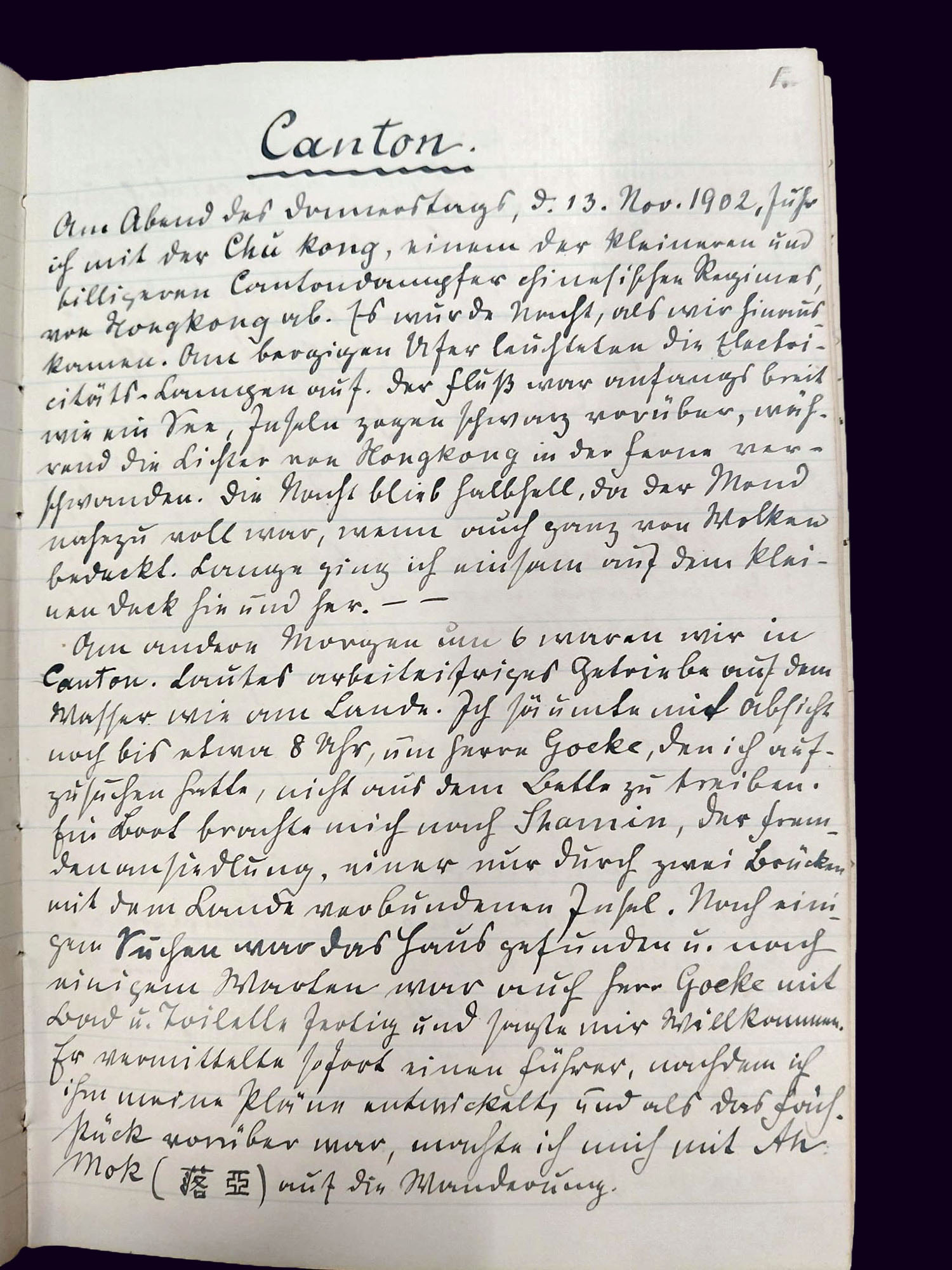
“In other correspondence mentioning Hackmann’s estate, there is no attestation of my presence and other artefacts, such as an ancestor tablet with my owner’s annotations and Chinese characters. Where am I in Hackmann’s writings? He was a prolific writer and took notes of his travel and ethnographic experience. However, how can my presence be discerned in Hackmann’s writings, which are buried in a Sütterlin script (an historical form of German handwriting script), hardly readable by contemporary researchers, especially if they are not native German speakers?”
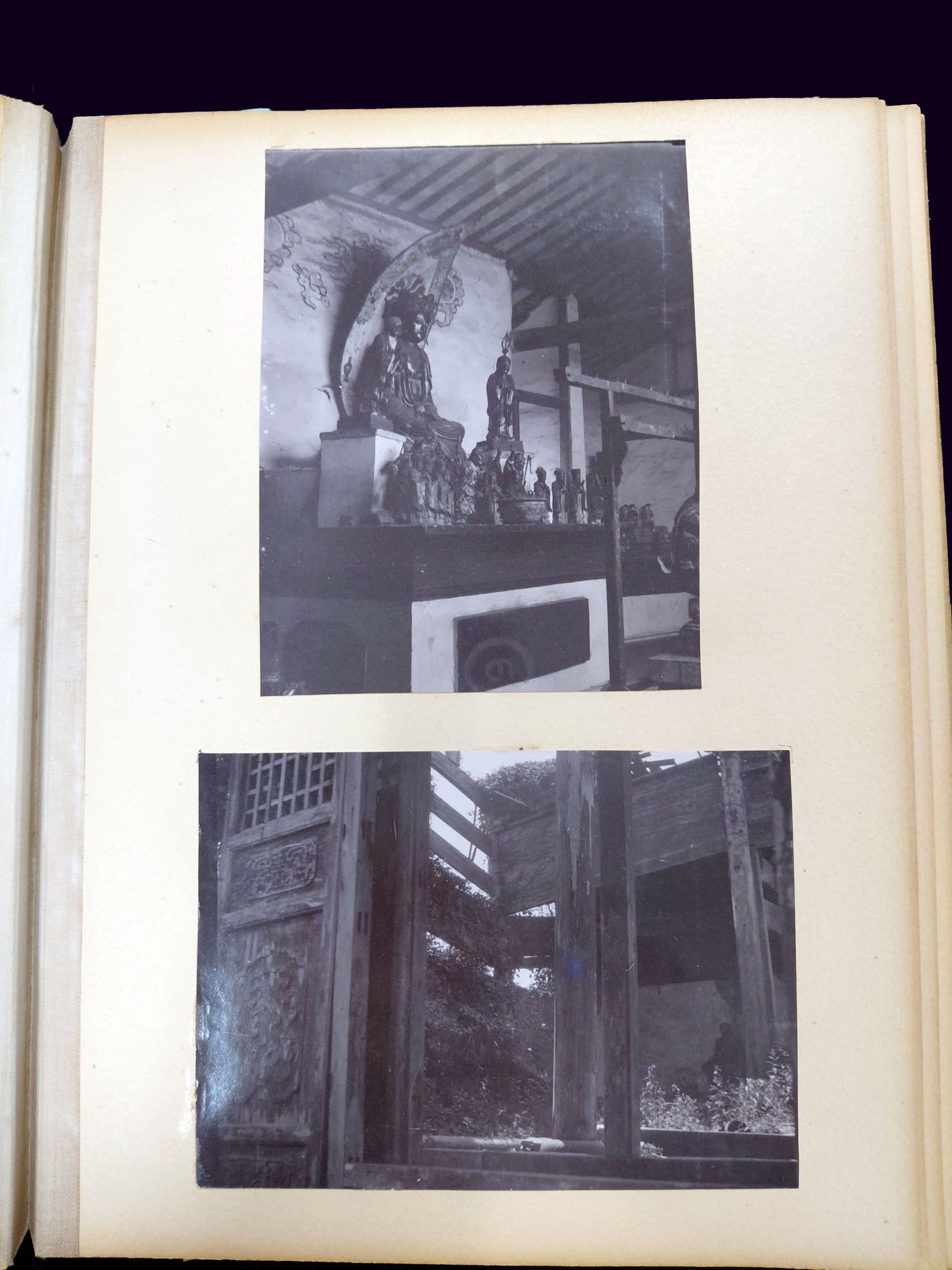
“What can be understood so far is that I would probably epitomize some dreams of decadence and a need for spiritual renovation. In Hackmann’s monograph Revival: A German scholar in the East (1914), derived from his diaries, a temple dedicated to me had
“the roof […] in ruins, but the branches of an aged pine fill up the deficiencies. The door is shut, and night is sinking lower and lower over the hills. The fitful gleams of my candle sparkle on the raindrops which the old pine has shaken into the temple. Old, long-established, well-fed spiders have spun their webs over the walls and into the corners. Bats flit fitfully in and out. […] The raindrops glisten in the candlelight, which casts a trembling gleam on the picture of the goddess, beneath which is written the prayer: “Guard our children and grandchildren.”
Hackmann saw me as a comforting mirage, to the point of inducing him to sleep where I should be revered.”

“Guanyin, in listening to your words, I sigh. I also witnessed missionaries sleeping in front of me, if not even cursing or comparing me to their Christian evil. You can see me now in the storage room of the Museo d’Arte Cinese ed Etnografico, established in 1901 by Xaverian missionaries. As in the case of your fellow friends, Rudolf Otto and Heinrich Frick, the Catholic Bishop Guido Maria Conforti thought to offer a space where seminarists, missionaries and Parma citizens could be educated in Chinese culture and religion. This education, alas, was intended to improve ways to convert my worshippers to their god. As described in missionaries’ novels and travel accounts, Chinese folk religious worshippers and Buddhists came into contact with these Italian missionaries and Chinese Catholics, who told them that their religion was stronger in defeating ghost spirits that were attacking them and bringing misfortune. Chinese believers, in the missionaries’ descriptions, seemed already to desecrate me and other gods if we were not capable of granting their requests. What a missionary described as a god of water was buried in the soil and beaten because there was no rain for weeks despite pilgrimages and offerings dedicated to him. This hate towards us was so high, in the missionaries’ fantasies, that even new converts swear to the Christian god their hatred for us. Despite their hatred towards us, these missionaries also wanted to show, through their museum, the richness of Chinese culture, demonstrating that my worshippers were highly civilized but needed a prophet to show their Christian truth and change their faith. As there are no voices from my worshippers to testify that my destruction and desecration happened, what is true and what is missionary propaganda, my dear Guanyin?”
“I know what you mean, Buddha. I was, for a long time—even by the Italian missionaries you mentioned—considered as the Asian Virgin Mary. These scholars and missionaries assumed that my protection of mothers and children, as well as any iconographic similarity with Mary, was likely influenced by Christianity, given the earlier presence of saints and missionaries in China. The Director of the museum, Frick, visited the Museum für Völkerkunde in Frankfurt in 1938 and found confirmation of his ideas about me. I was a “Chinese Madonna” even there. Frick found this similarity important for declaring that non-Christian religions possess a Christian truth that must be revealed through missionaries’ zeal.”
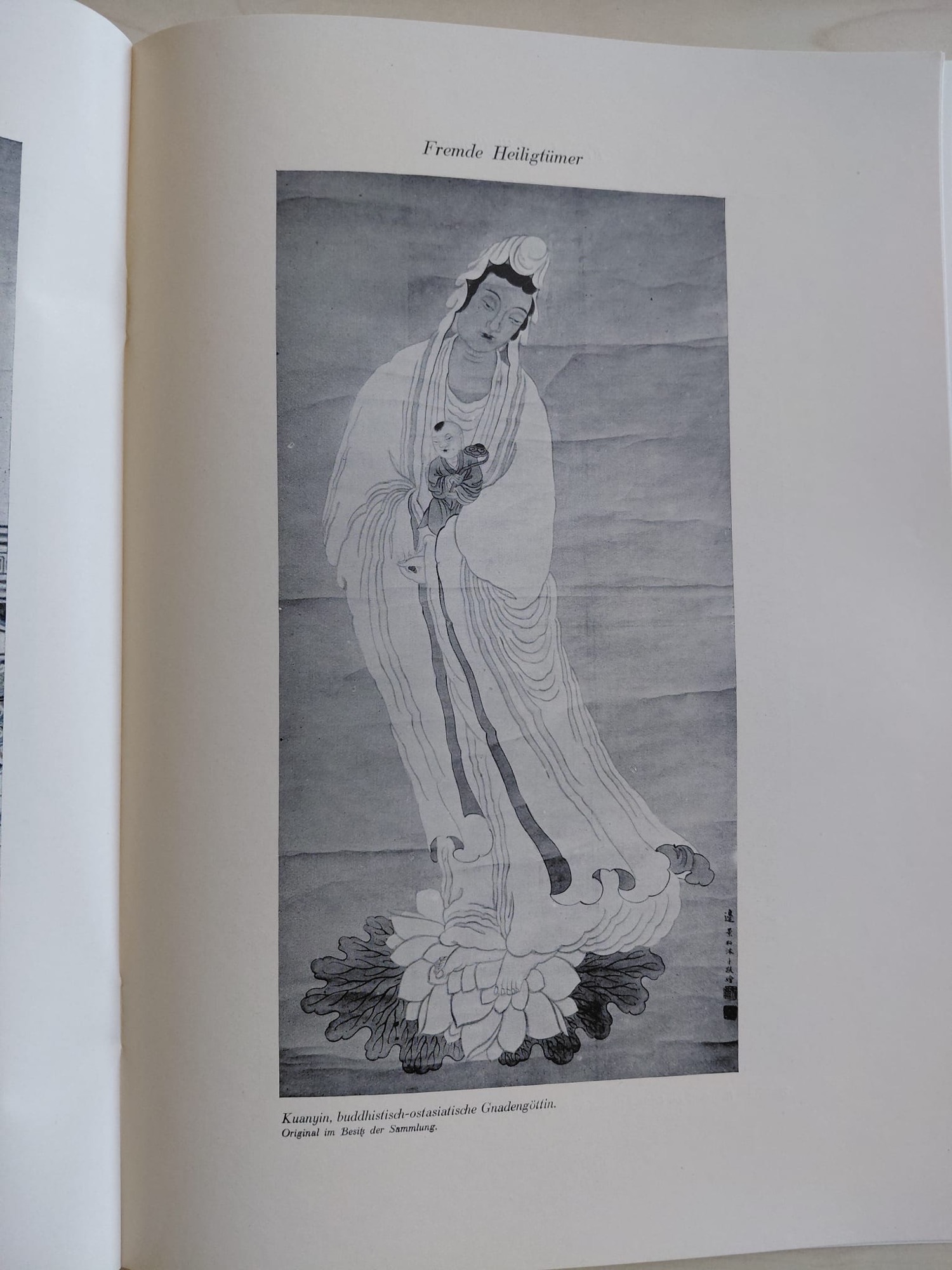

“With the exhibition Fremde Heiligtümer (Foreign Sanctuaries), inaugurated in 1929, two years after the opening of the Religionskundliche Sammlung on the occasion of the university’s 400th anniversary, I was placed alongside Confucius and Taoist saints, separated from you, Buddha! I cannot explain this decision, as the museum curators “deliberately refrain from naming each individual object.” I was still an idea in Frick’s intention, as I was exhibited as a temple engraving rather than in the shape of a statue. I was the result of this concluding motto of the exhibition “Right mission is the natives’ best friends”. What truly happened to us, transforming into museum artefacts, we cannot say other than our European collectors and curators’ projections and interpretations of us.”
“We hope, dear Guanyin, that some human can hear our whisper—although not clearly—and start to work on some hypothesis about our holes. There are descriptions of conversions and rituals related to the consecration of statues by Italian missionaries that could support my hypothesis. We are hollowed in order to receive sacred substances that reinforce the gods’ spirits during consecration rituals. Opening the hollow again could have been made by the missionaries themselves to find out what was inside us after witnessing some rituals of consecration. It could also be done by converts when they donated to the missionaries or art dealers. As we no longer had any spirit inside us, we should have been emptied to return to be a piece of wood.”

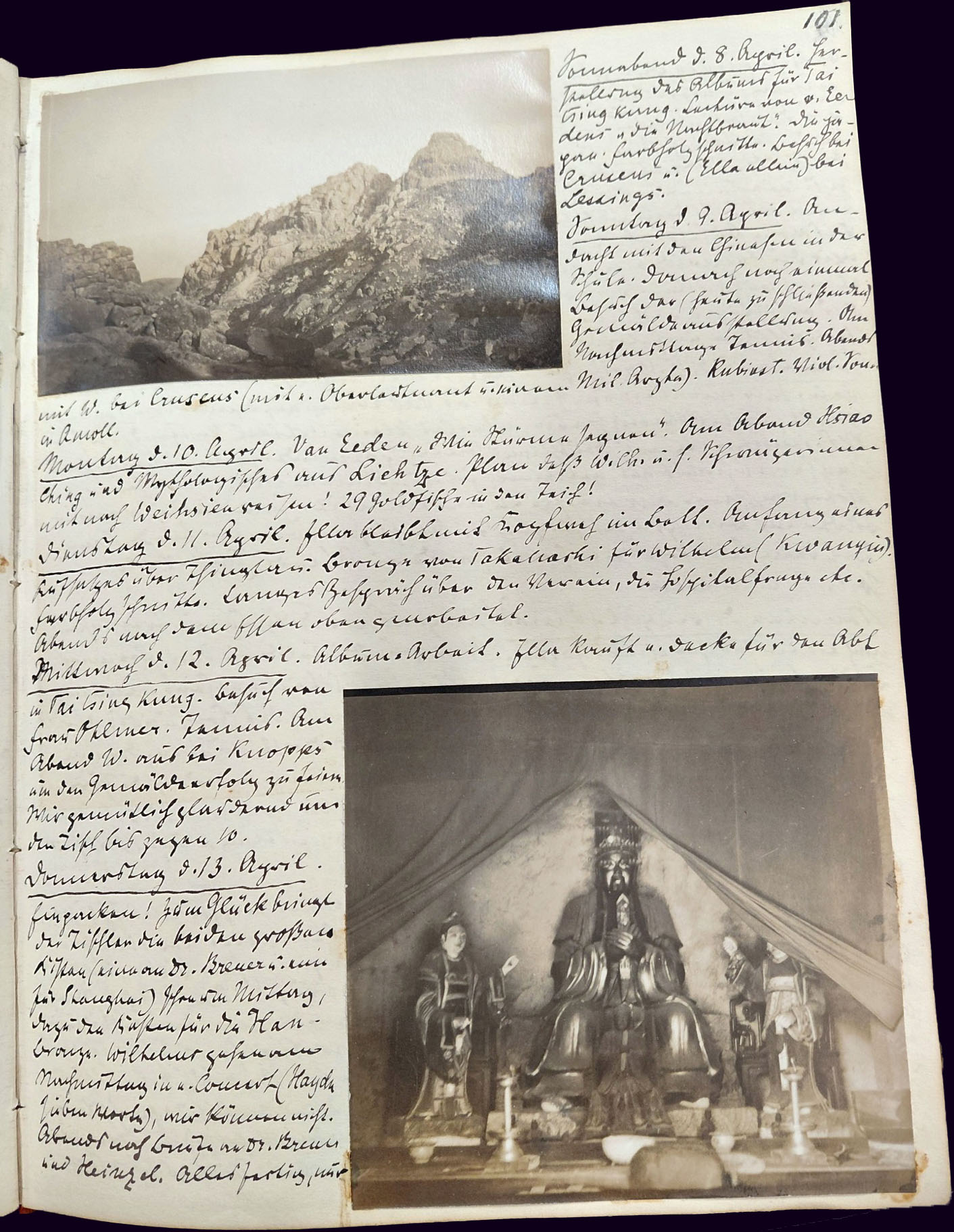
“Yes, Buddha, these are good guesses, not sure if someone could determine which one, though. One century has passed since our collection was established, and our collectors were inconsistent in annotating any information related to us and our previous owners. Perhaps they did not find it important or were unaware. In this way, they silenced our voices and made any reconstruction of the latter much more complicated.”
“Alas, Guanyin! Please, switch the subject, it is so frustrating not to be heard by humans!”